Creative Christmas Decoration Ideas with Cement Cones

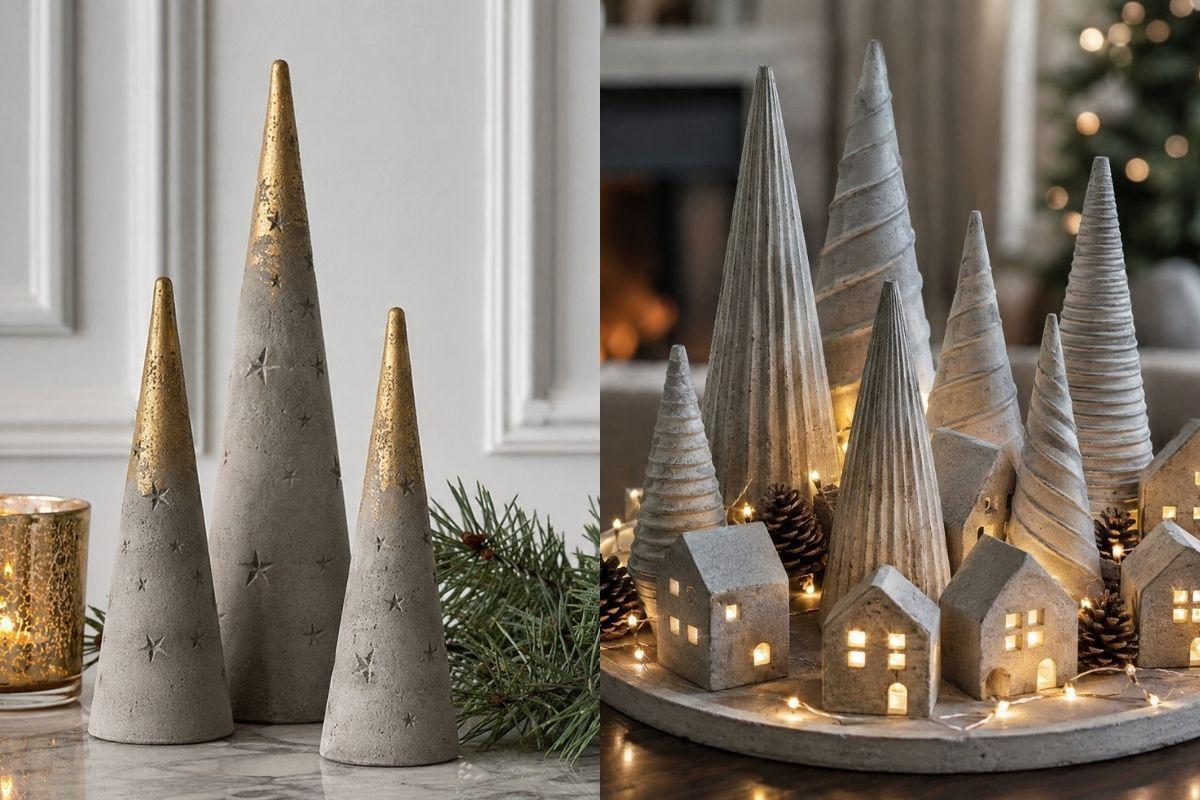
Christmas decorating does not always have to mean glitter, plastic ornaments, and the same red-and-green combinations we unpack every December. Sometimes the most memorable decorations begin with an unexpectedly simple material.
Cement cones are a perfect example.
Minimalist, inexpensive, and wonderfully adaptable, these cone-shaped decorations can become modern Christmas trees, snowy Scandinavian ornaments, candlelit centrepieces, rustic woodland scenes, or sophisticated metallic accents.
Their beauty lies in the contrast: raw cement feels solid and architectural, while Christmas decorations are traditionally soft, bright, and nostalgic. Bring the two together and something interesting happens.
1. Minimalist Cement Christmas Trees
Start with the simplest version.
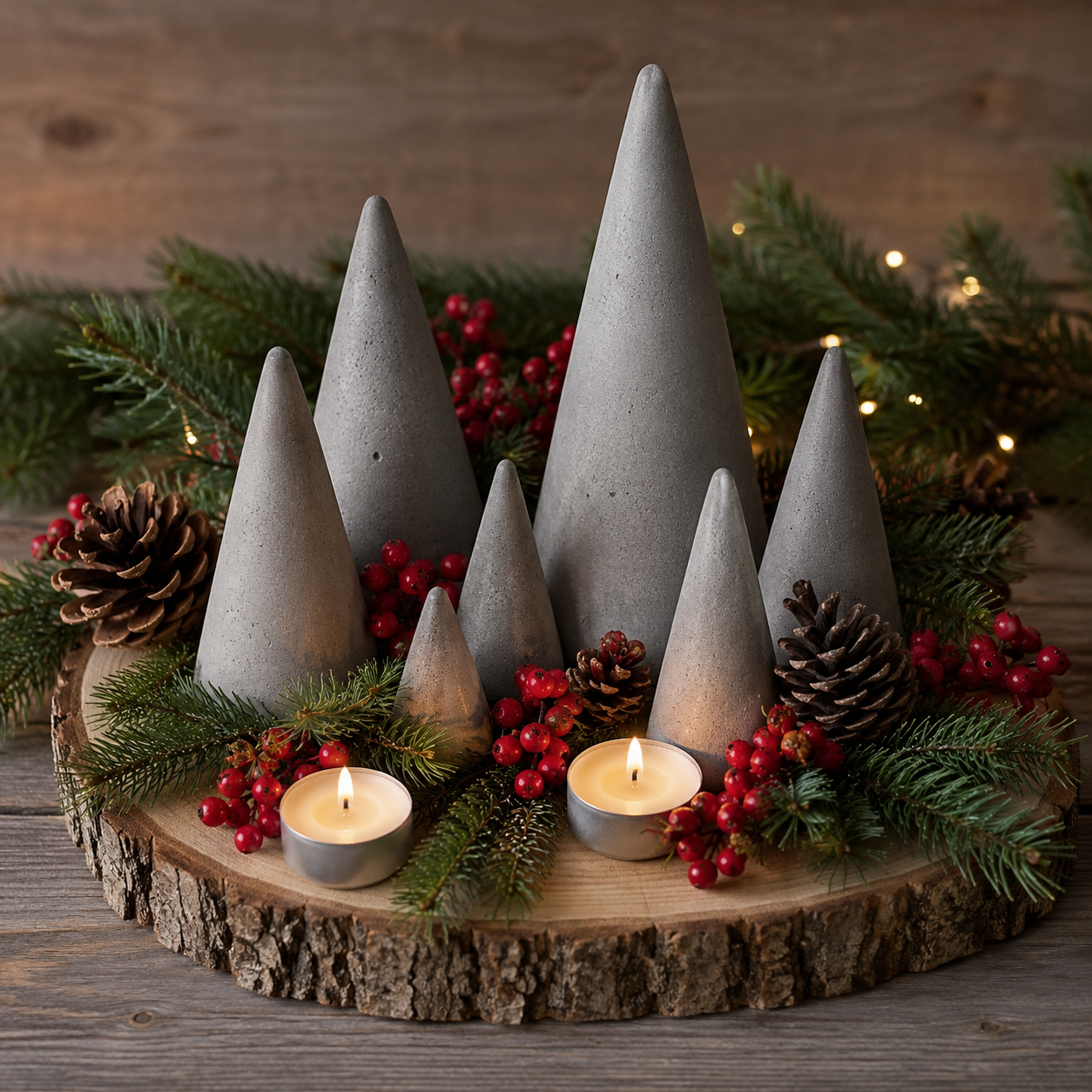
Cast several cones in different heights and leave the cement completely natural. Arrange three or five together on a wooden console, mantelpiece, or dining table.
The slight imperfections in the surface are part of the charm.
For a modern look, combine:
- one tall cone;
- two medium cones;
- two smaller trees;
- a few natural pine branches;
- simple white candles.
There is no need to paint everything.
In fact, the understated grey surface is precisely what gives these concrete Christmas trees their contemporary character.



2. Snow-Covered Cement Cones
A little white paint can completely transform the same design.
Instead of covering the entire cone, lightly paint only the upper portion and allow the white to descend irregularly.
The effect resembles freshly fallen snow.
For additional texture, use a dry brush rather than a perfectly smooth coat.
Place the finished trees on a wooden tray with pinecones and artificial snow for a winter woodland Christmas centrepiece.
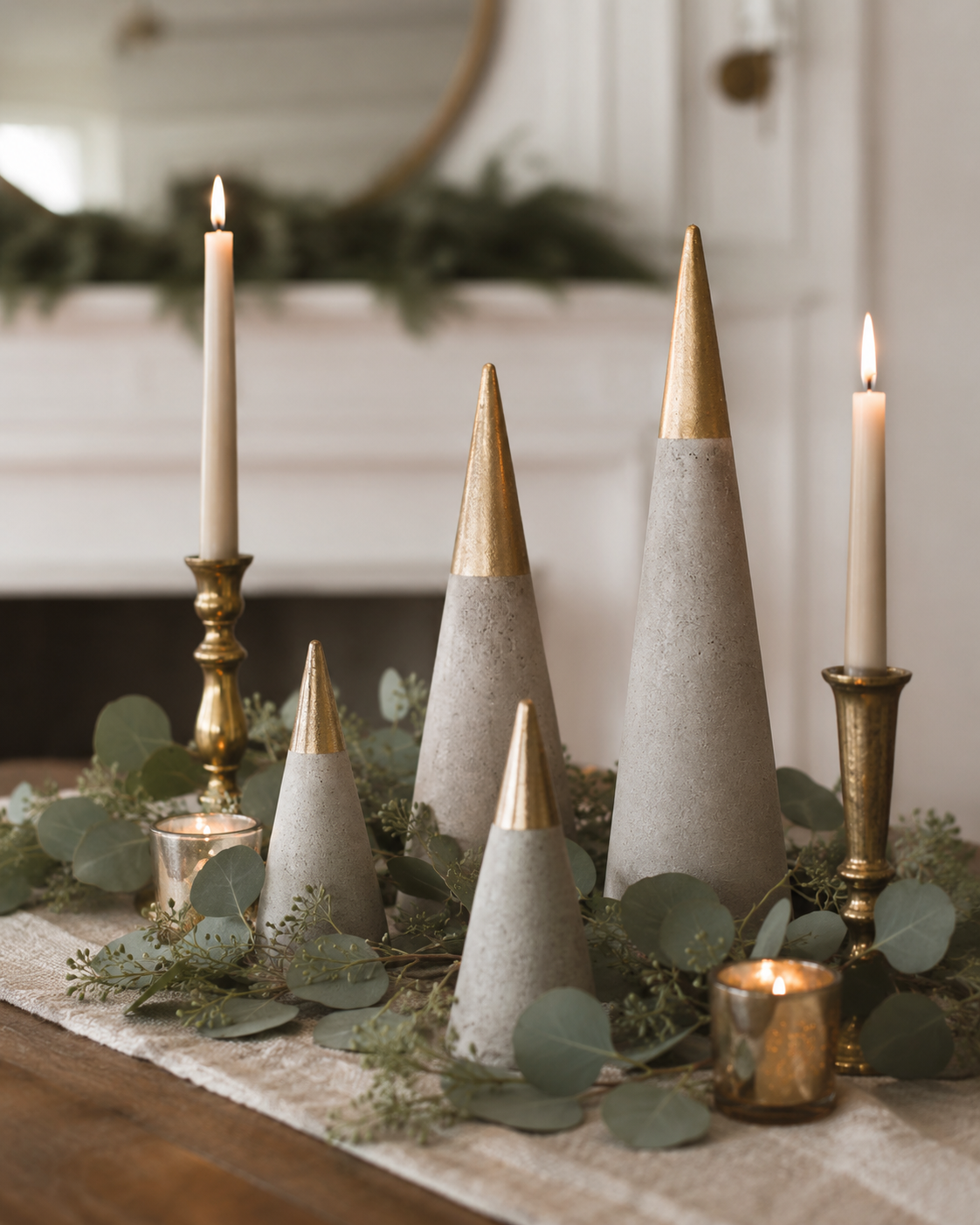
3. Gold-Tipped Christmas Cones
Grey and gold make an unexpectedly elegant pairing.
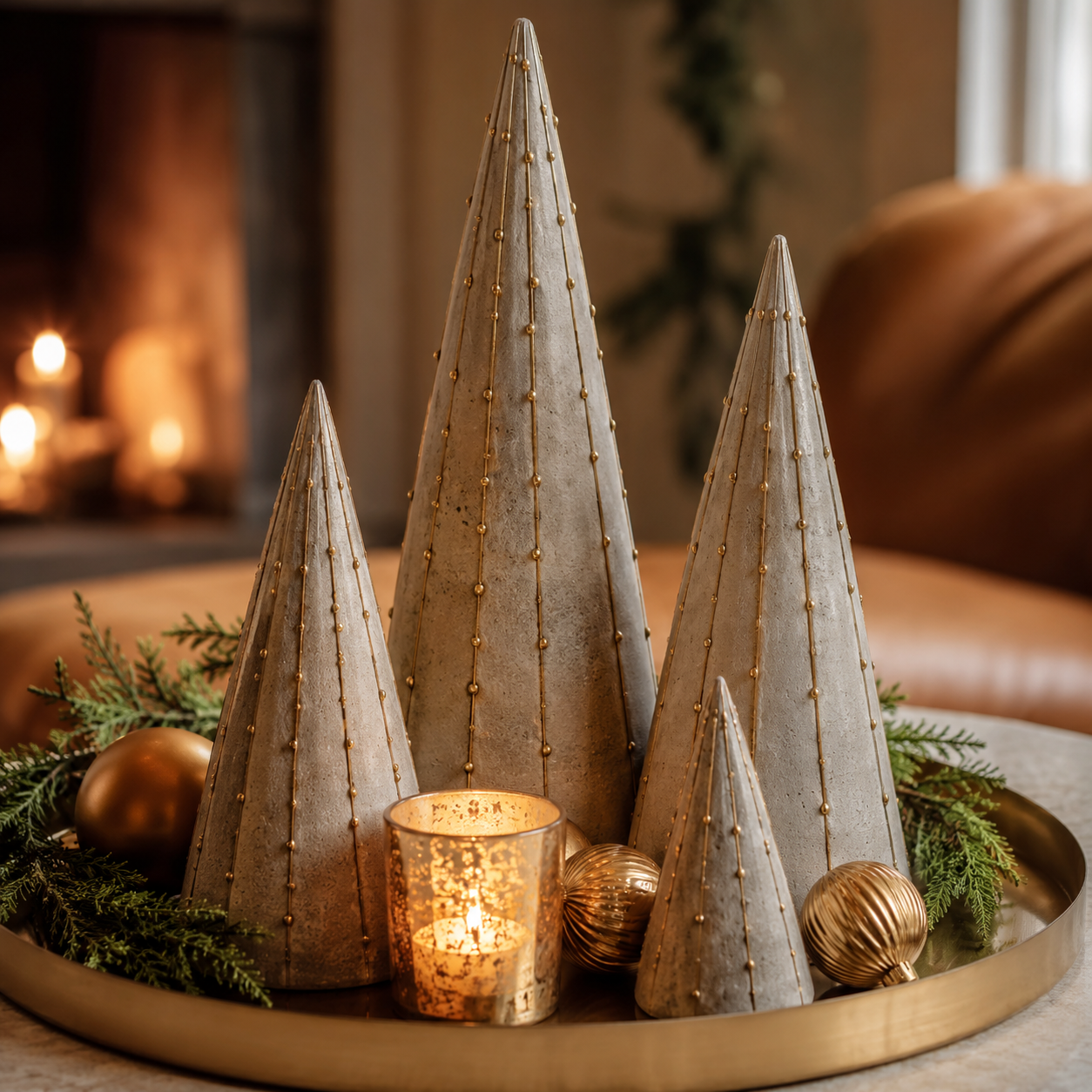
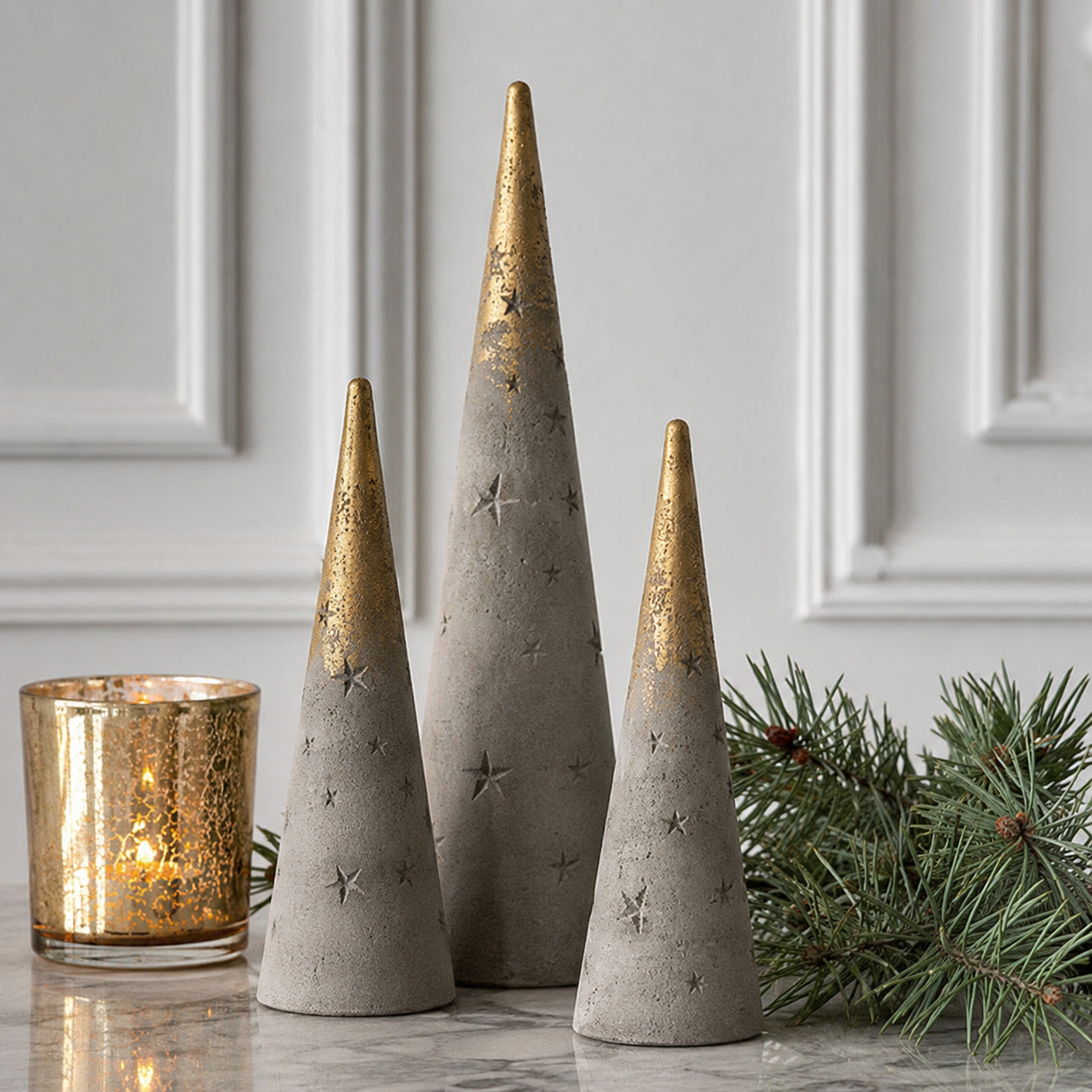
Leave most of the cement exposed and paint only the tip with metallic gold.
Another option is to create an irregular gold band around the lower third of the cone.
The finish does not have to be perfectly geometric. Slightly distressed metallic paint can actually make the decoration look more handcrafted and sophisticated.
These cones work beautifully alongside:
brass candleholders, cream candles, linen table runners, eucalyptus and warm fairy lights.
4. Tiny Cement Trees with Stars
Before the cement sets completely, create a small opening at the top where a decorative element can later be inserted.
Once cured, add a tiny wooden, wire, or metal star.
Suddenly, an extremely simple cone becomes instantly recognisable as a Christmas tree.
Keep the star natural for a rustic aesthetic, or use gold for something slightly more festive.
For a softer Nordic interpretation, use white cement or finish your cones in a warm off-white shade.
Pair them with pale wood and simple natural materials.
Think:
- unfinished wooden beads;
- linen;
- dried branches;
- white candles;
- small pinecones;
- neutral ceramics.
The result feels festive without becoming visually crowded.
This is particularly effective in homes decorated in Scandinavian, Japandi, minimalist, or neutral Christmas styles.
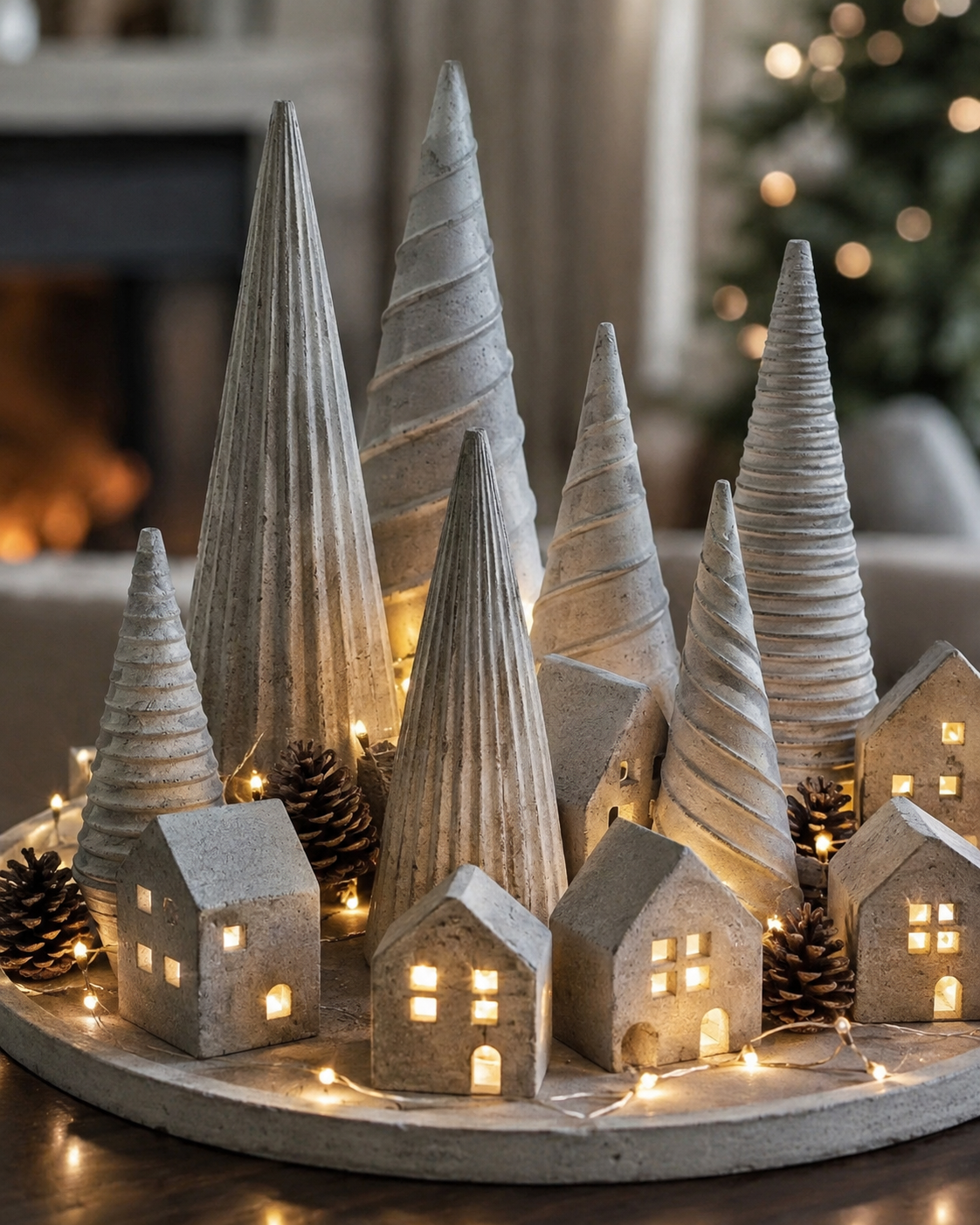
6. Textured Cement Christmas Trees
Smooth cones are beautiful, but texture can make them even more interesting.
Before casting, experiment with moulds that create subtle ridges, spirals, geometric patterns, or horizontal lines.
Another possibility is adding texture after demoulding.
Small grooves carved into the surface can suggest branches without trying to reproduce a realistic tree.
The trick is restraint.
A few intentional marks often look better than an overly complicated pattern.
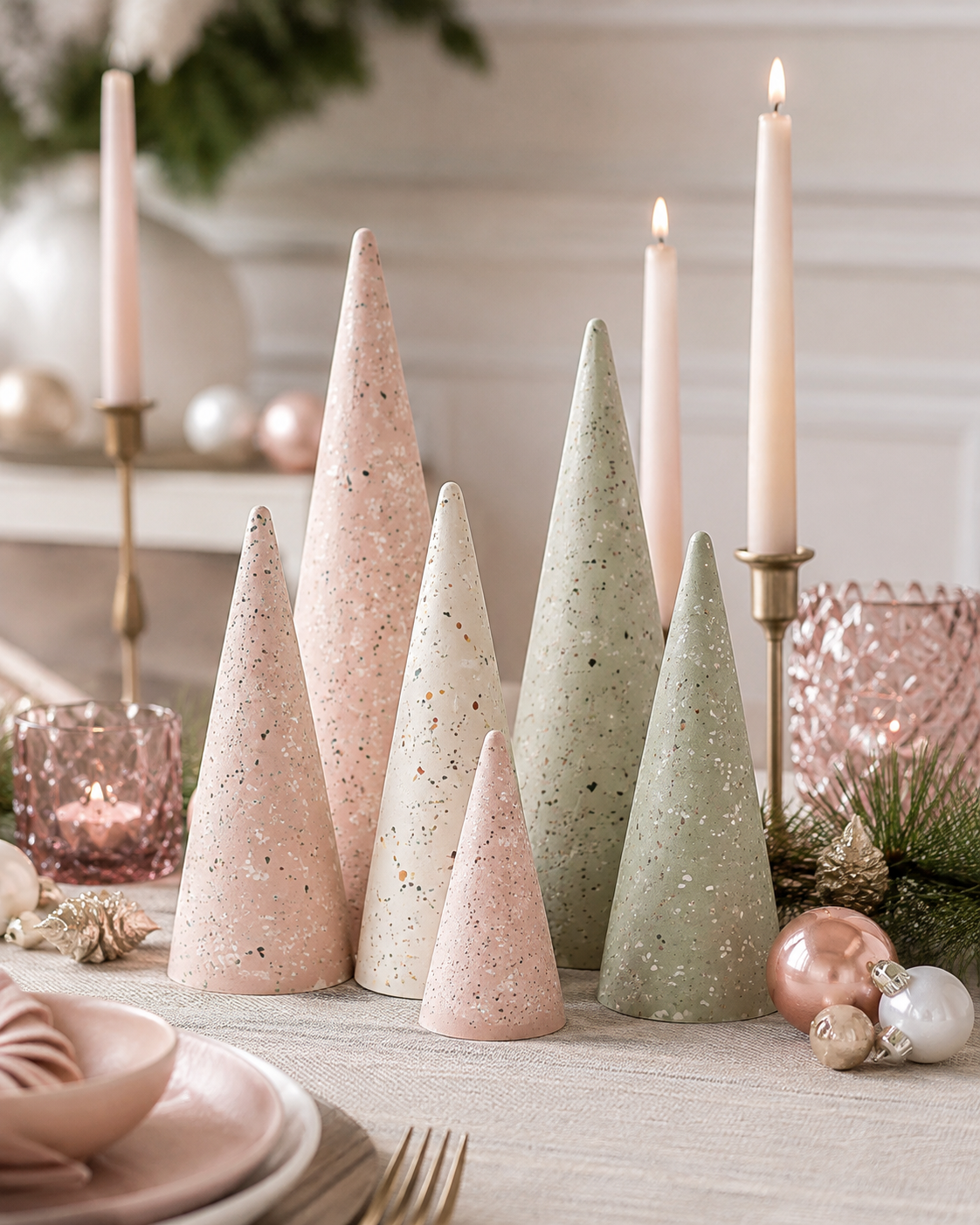
7. Forest-Green Cement Cones
Cement does not need to stay grey.
Paint several cones in slightly different shades of forest green:
- deep pine;
- muted olive;
- sage;
- almost-black green.
Leave parts of the cement visible around the base for a more handmade appearance.
Grouping different shades together creates depth while maintaining a sophisticated palette.
A handful of tiny gold stars can provide just enough Christmas sparkle.
8. Cement Cones with Tiny Lights
One of the prettiest evening displays involves combining cement trees with micro LED lights.
Instead of wrapping every cone individually, arrange the trees as a small forest and weave a fine wire light strand loosely between them.
The glow reflects softly against the cement surfaces.
Place the arrangement on a sideboard or mantelpiece and keep everything else intentionally simple.
It is atmospheric without becoming excessive.
How to Make Basic Cement Christmas Cones
The basic method is surprisingly approachable.
You will need
- A suitable cement or fine concrete casting mix
- Cone-shaped moulds
- Water
- Mixing container
- Mixing tool
- Waterproof gloves
- Eye protection
- Fine sandpaper
- Optional paint or decorative finishes
Step 1: Prepare the mould
You can use ready-made cone moulds or create simple disposable forms from suitable materials.
Make sure the mould stands securely upright before filling it.
Step 2: Mix carefully
Follow the water ratio recommended by the manufacturer rather than guessing.
Spoon or pour the mixture into the mould.
Step 4: Allow it to cure
Do not rush the demoulding stage.
Always follow the instructions for your particular material.
Step 5: Finish the surface
Once sufficiently cured, gently sand any sharp or uneven areas.
Then decide whether your tree stays beautifully raw or receives paint, metallic details, snow effects, ribbons, or other embellishments.
Create a Whole Cement Christmas Village
One cone is decorative.
Seven cones become a landscape.
Make several in different sizes and combine them with miniature houses, candles, wooden stars, moss, branches, or pinecones.
Avoid making every tree identical.
Different heights and subtle variations create a far more convincing arrangement.
For example:
tall natural cement tree + small white tree + medium sage tree + tiny gold tree.
This uneven combination feels collected rather than mass-produced.
Why Cement Cones Work So Well at Christmas
Perhaps their biggest advantage is versatility.
A plain cone does not dictate a particular Christmas style. It can become industrial, rustic, Nordic, glamorous, traditional, or contemporary depending entirely on what surrounds it.
And unlike highly themed decorations, cement Christmas ornaments can easily evolve from one year to the next.
This Christmas they may be grey and gold.
Next year, perhaps white and sage.
After that, completely natural.
The object remains the same. Only the story around it changes.