Crystal terrarium ideas for magical home decor


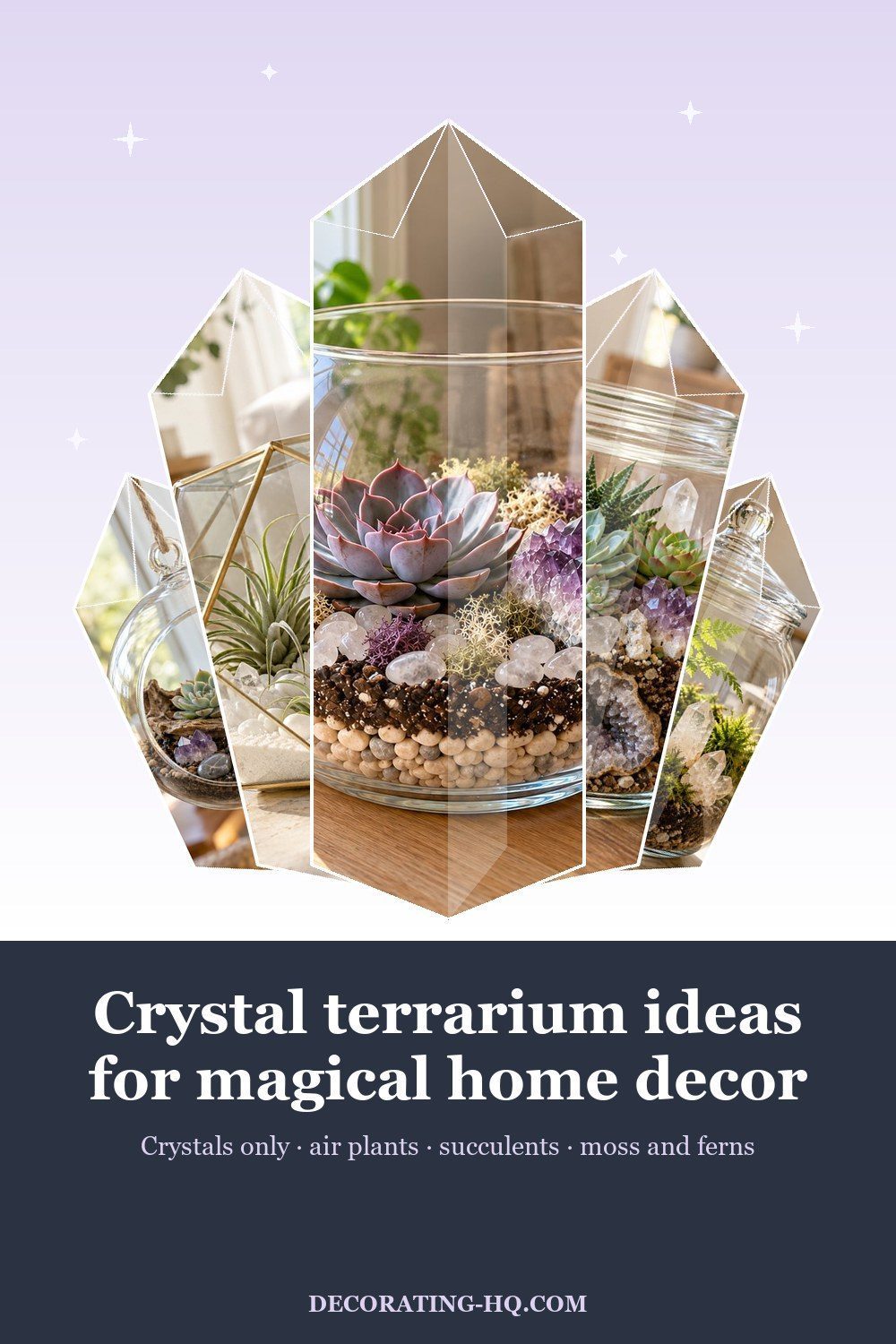
A crystal terrarium can hold crystals only, air plants, succulents and cacti, or moss and ferns. Choose open glass for succulents and air plants, and closed glass for moss and ferns, following Oregon State University Extension and Iowa State University Extension and Outreach. The quartz-point air plant bowl, which DIYS.com says takes a couple of minutes, is the quickest idea; the open succulent-and-amethyst bowl is the showpiece. Start with the living contents, then choose glass and stones around them.
Choosing crystals, glass and plants
Keep the crystal collection small enough that the plant remains easy to reach. Clear quartz points give a sharp silhouette; an amethyst cluster gives a broad purple focal point; an open geode supplies a little rocky landscape. These are purely decorative choices. Match the planting to the vessel before arranging the minerals. A dry display also suits a shelf where you want the appearance of a miniature garden without managing living greenery. For the succulent versions, treat the bowl as a container garden that needs deliberate watering.
| Inside | Container | Light and water | Source |
|---|---|---|---|
| Crystals only | Dry globe or small jar; faux greenery optional | Plant-free display; dried flowers, dehydrated moss and faux plants stay decorative | Garota Hipster and Michaels |
| Air plants | Open glass with room to lift plants out | Bright indirect light and airflow; weekly: mist well or soak 30 minutes, then let them dry upside down for several hours | Illinois Extension and Oregon State University Extension |
| Succulents and cacti | Wide-open glass; drainage holes preferred | Abundant light, cactus mix and complete soil dry-down; often monthly watering or less | University of Minnesota Extension and Oregon State University Extension |
| Moss and ferns | Closed or semi-closed glass | Medium to bright indirect light; many closed terrariums need water every 3 to 6 months, depending on conditions | Iowa State University Extension and Outreach |
Crystals only, no plants
Dried-flower globe with an amethyst centerpiece
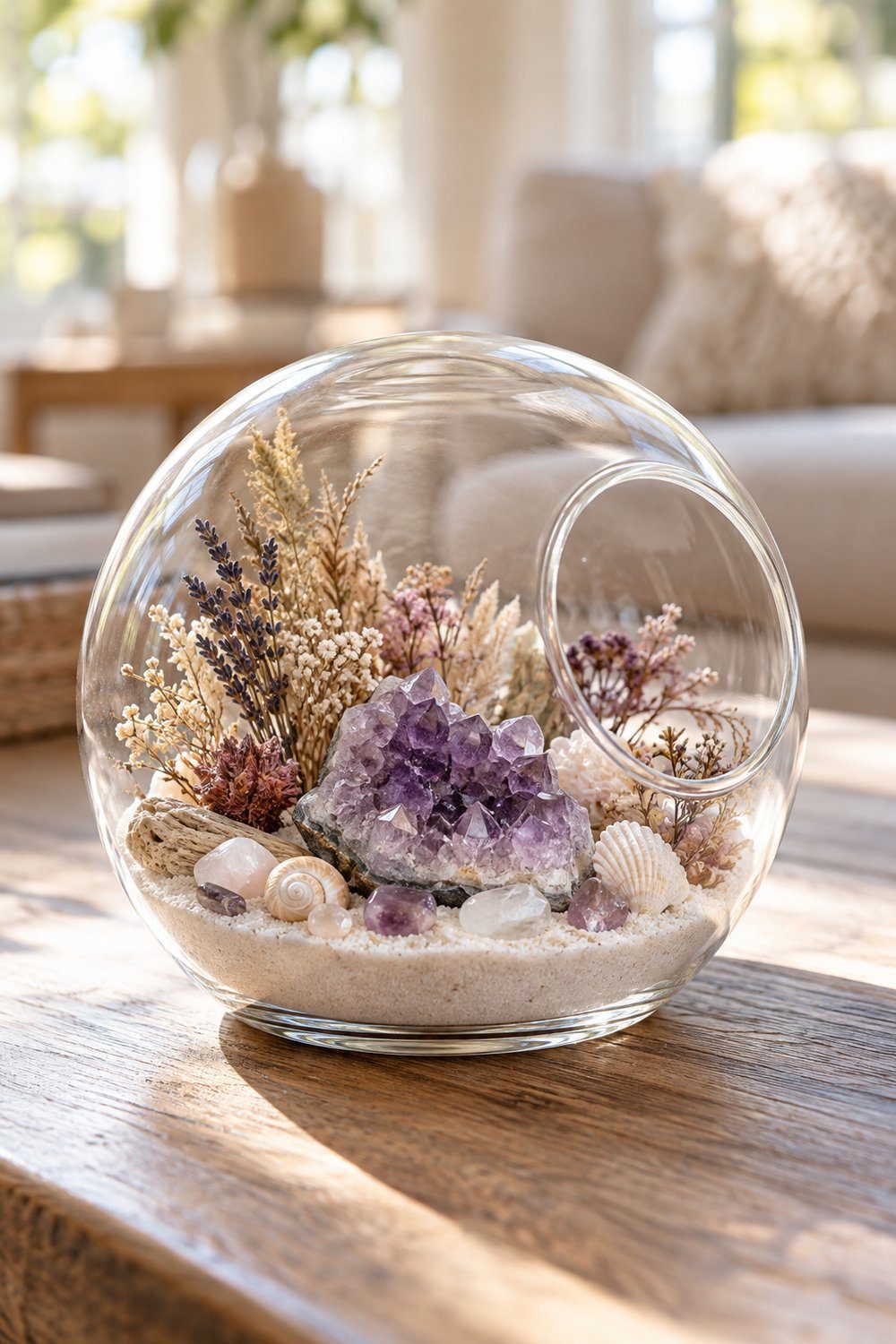
A front-facing amethyst gives this dry globe a clear center, with dried grasses making a soft backdrop. This House of Moss kit uses sand, miniature gemstones and dried stems; trim any stems taller than the globe, or push them into the sand. Finish with shells and the larger amethyst at the opening. Set the flat base on a bookcase or entry table; Aimsy says to rest this particular globe on its base because its hanging tip is delicate. The dried flowers add height while leaving the purple stone visible through the glass.
You'll need: 1 flat-bottomed glass globe, sand, miniature gemstones, dried flowers and grasses, shells and an amethyst centerpiece.
Tutorial by Aimsy, Aimsy's Antics
Miniature amethyst garden in a jelly jar
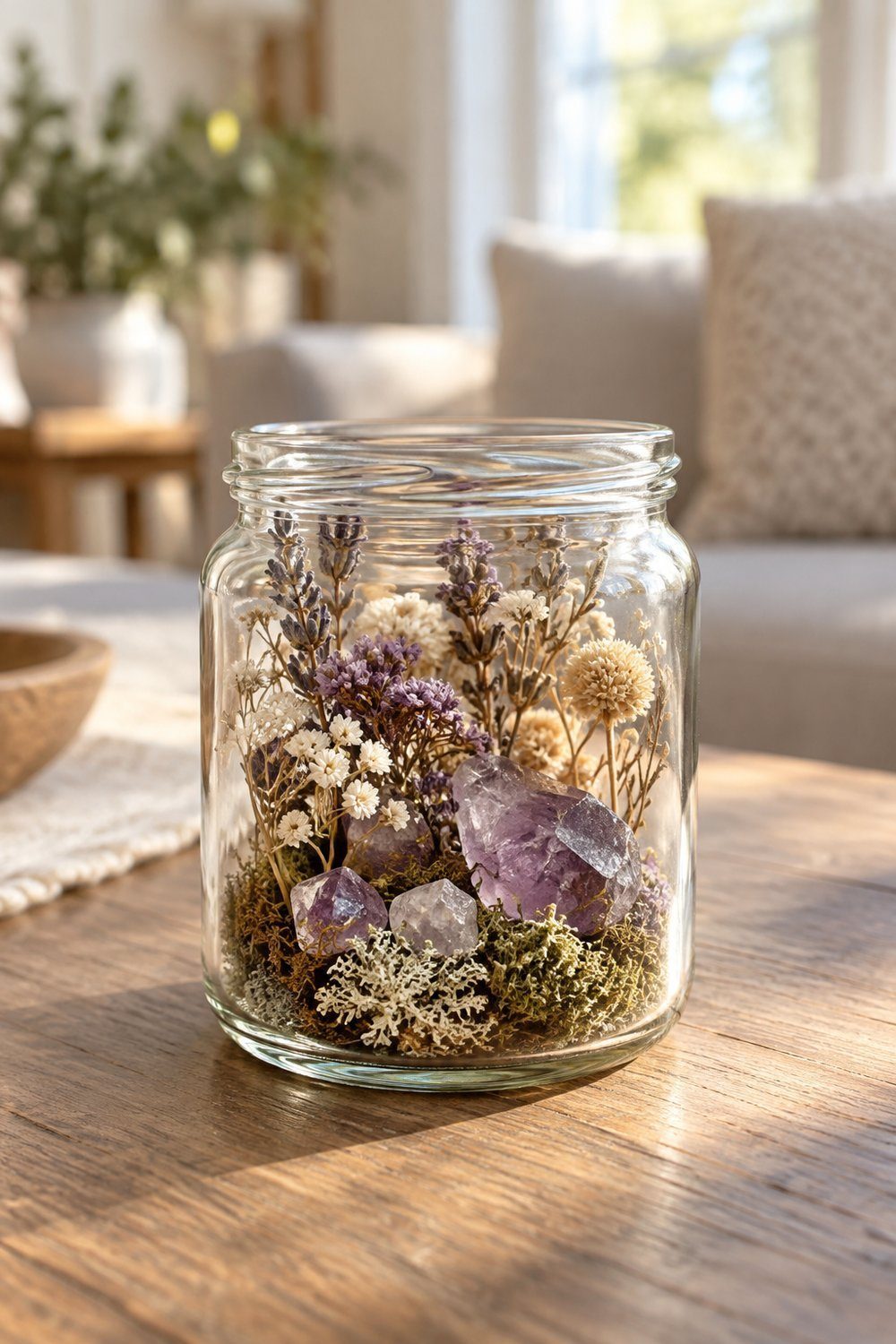
A jelly jar makes a simple miniature amethyst garden. Fix dehydrated moss and dried flowers inside the glass with craft glue, then secure the amethyst pieces with removable mounting putty. The tutorial includes an optional charm; here, leave it out so the stones take the foreground. Place the jar beside framed photographs or on a desk, with the crystal faces turned toward the viewer. This is a dry arrangement with preserved materials, and its appeal comes from the contrast between rough purple mineral and fine stems.
You'll need: 1 jelly jar, dehydrated moss, dried flowers, amethyst pieces, craft glue and removable mounting putty.
Tutorial by Garota Hipster, Garota Hipster Vlog
Lighted quartz display with faux succulents
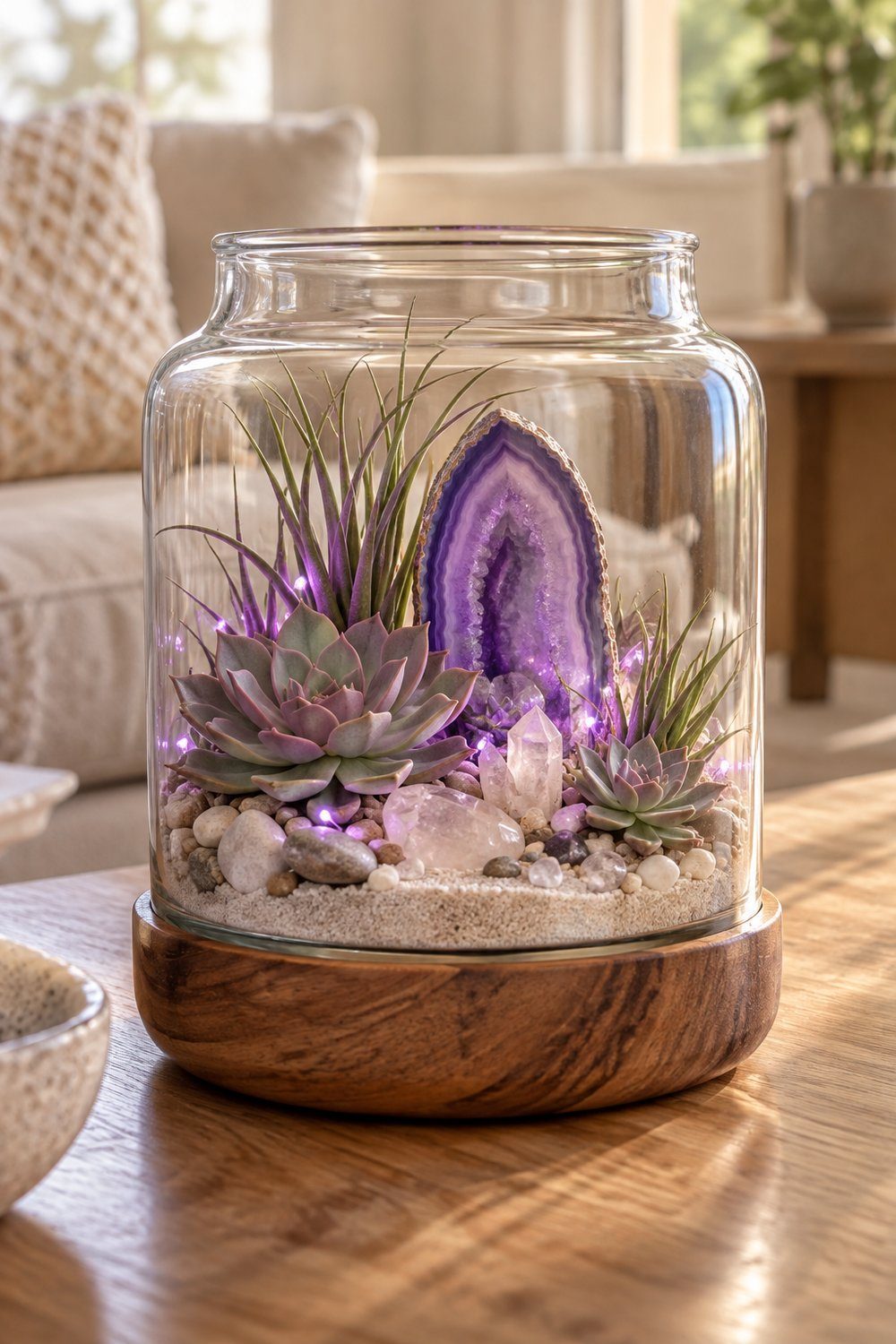
Small lights turn quartz edges into the main detail in this faux garden. Add sand and rocks to the wooden-base jar, arrange the light strand, and screen its battery pack with the purple agate slice. Trim and tuck the faux echeveria and river-grass picks around the stones. Despite the tutorial’s amethyst title, its materials identify clear quartz and purple agate; keep those names when shopping. This version suits a console or sideboard, with the artificial foliage giving it a finished garden shape.
You'll need: 1 glass jar with a wooden base, clear quartz, purple sliced agate, decorative lights, sand, rocks and faux plant picks; Michaels estimates about 30 minutes.
Tutorial by Michaels, Michaels
Air plants and crystals
Make the air plant removable before arranging the crystals around it. According to University of Illinois Extension, bright indirect light, good air circulation and several hours of drying before returning plants to glass support healthy growth. An opening that faces the room also makes the arrangement easier to maintain.
Gold geometric case with air plants and crystals
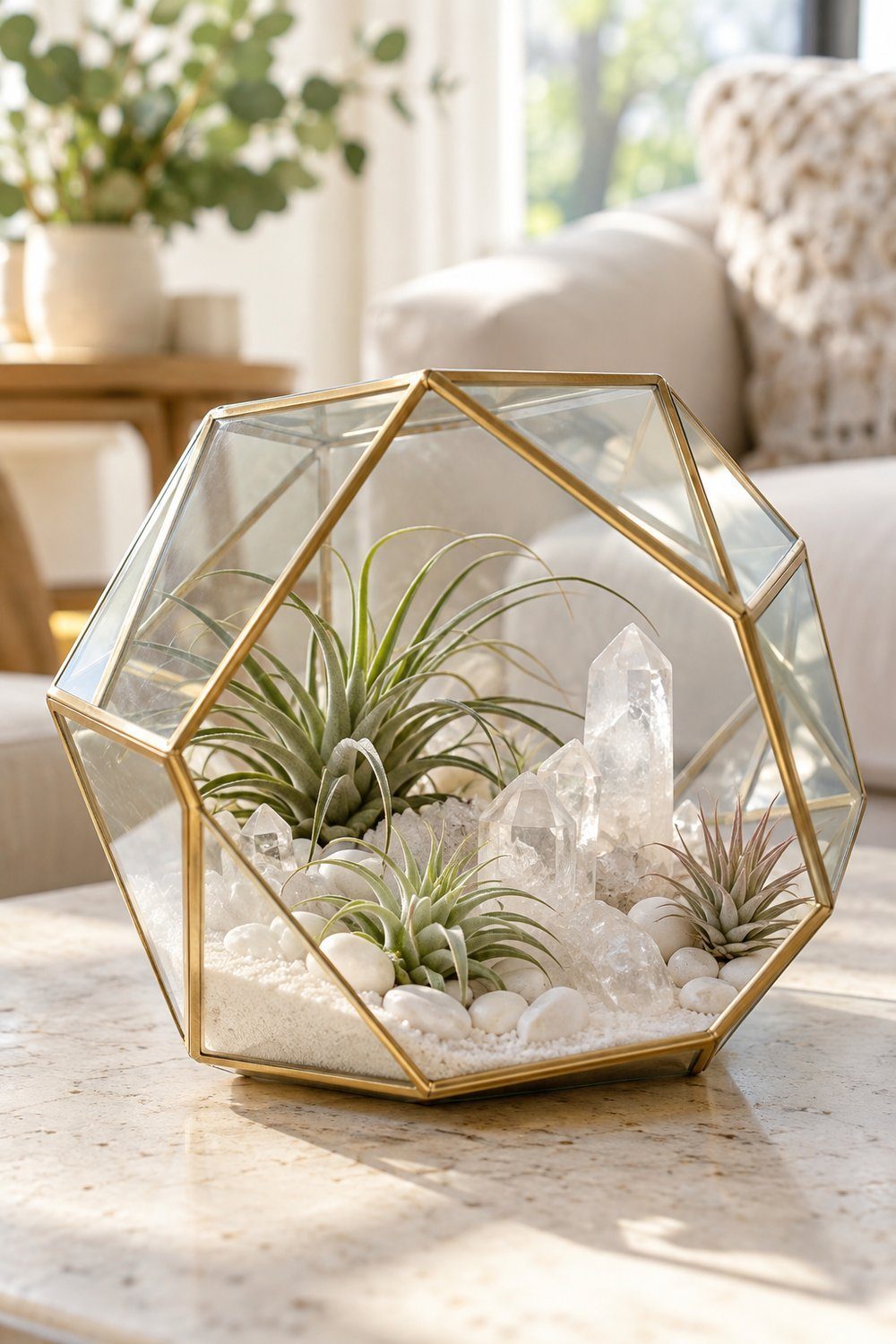
A gold frame gives white sand and rough stones a tidy outline. Turn the geometric case onto its side with the opening facing outward, add the sand, then cover most of it with white pebbles. Set the air plants and crystals on top. Twinspiration uses assorted raw crystals without identifying each mineral; here, choose clear quartz points for a restrained palette. Put the case on a bright side table with its open face accessible. The white base makes the plant’s narrow leaves easy to see.
You'll need: a medium geometric terrarium, 3/4 cup (180 mL) white sand, white pebbles, air plants and raw crystals.
Tutorial by Britta and Carli Garsow, Twinspiration
Quartz-point air plant bowl
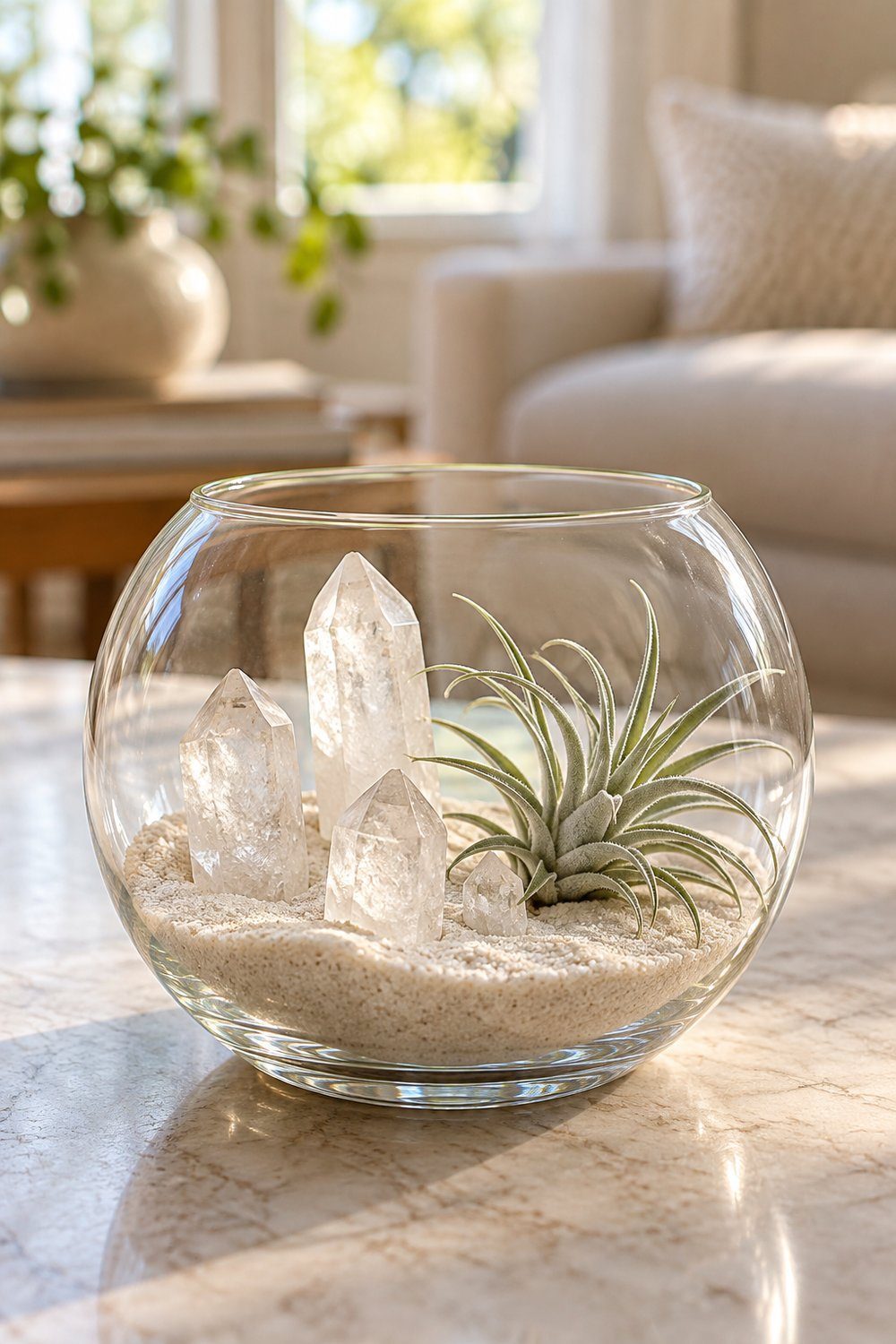
Upright quartz points make a small bowl feel like a miniature rocky outcrop. Pour in sand, press the crystal ends into it at varied heights, and settle the air plant next to the crystals. The tutorial adds a watercolor message flag; here, omit it for an uncluttered everyday display. This air plant crystal terrarium fits on a desk or beside a reading chair, where you can see through its low rim. Keep enough open sand around the plant to lift it out easily.
You'll need: a 3.5 in (9 cm) round open glass vessel, 1/2 cup (120 mL) sand, 3 to 5 rough quartz pieces and an air plant.
Tutorial by Jennifer Paglinawan, DIYS.com
Coffee-carafe air plant garden
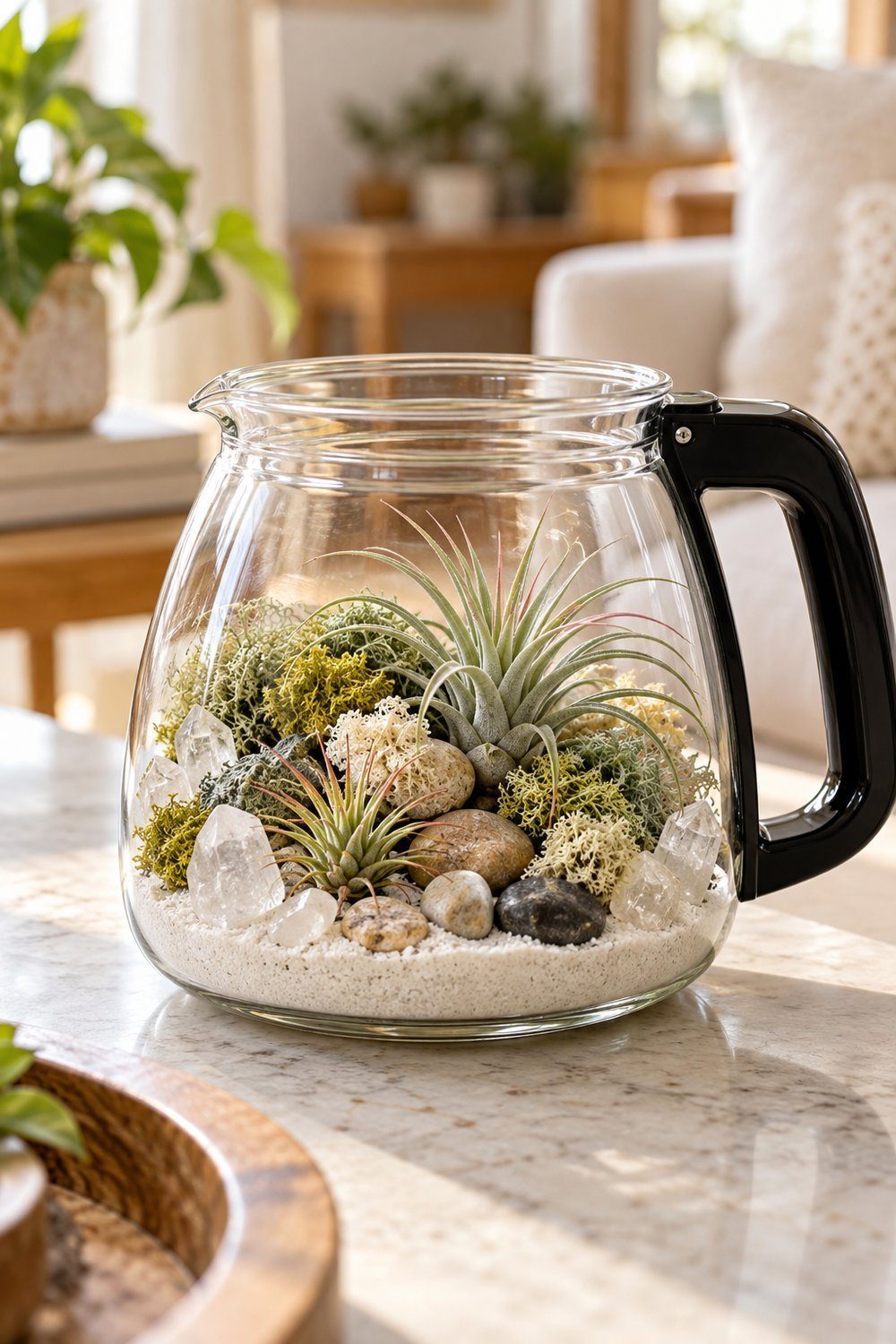
A coffee carafe brings a familiar kitchen shape to a tiny indoor garden. Spread white sand and river rocks across the bottom, arrange the mini air plants, then add decorative moss and gemstones around the perimeter. Enid’s tutorial leaves the gemstone varieties and moss status unspecified; here, use clear quartz and dry preserved moss. Display the carafe on a breakfast-room shelf; mist regularly or dunk once a week, as the source advises. Its handle makes the composition feel casual, while the clear sides keep the stone border in view.
You'll need: 1 reused glass coffee pot, white sand, river rocks, mini air plants, preserved decorative moss and quartz accents.
Tutorial by Enid / acharmingproject, Bored Panda
Succulents and amethyst: an open terrarium step by step
Give the succulent room first, then place the amethyst beside it. According to University of Minnesota Extension, succulents need abundant light and a well-drained medium, and containers with drainage holes are preferred. Its guidance also explains why gravel beneath soil in a dish cannot replace drainage. The showpiece below adapts the craft tutorial with cactus mix, no bottom gravel layer and the dry-down watering guidance from the care sources.
Open succulent bowl with amethyst and a squirrel
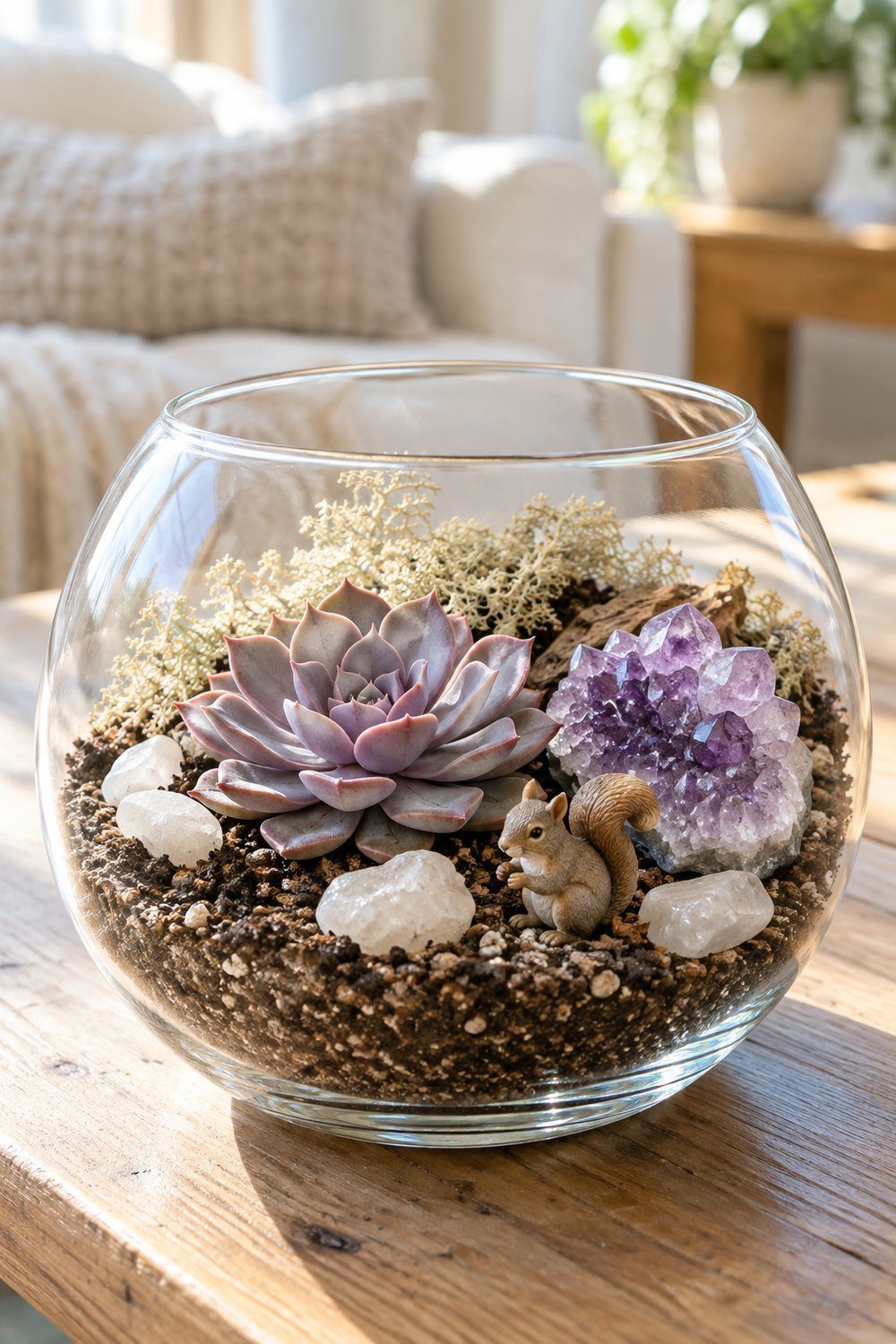
Tutorial by Daniela Kretchmer, AB Crafty
A purple-gray rosette, rough amethyst and a tiny squirrel make this an inviting tabletop scene. Daniela Kretchmer’s version uses dried moss toward the back and a few quartz pebbles. Build the planted center, then arrange the dry accents so the rosette and crystal remain distinct. Set the finished bowl on a bright plant table where you can reach the soil easily. Keep the figurine off to the side: the strongest part of the design is the contrast between fleshy leaves and jagged mineral.
You'll need: the source’s 2 in (5 cm) Echeveria ‘Violet Queen’, a wide-open glass bowl, cactus potting mix, dried decorative moss, an amethyst cluster, quartz pebbles, an optional squirrel figurine and a small scoop.
- A clean glass bowl with a broad opening for planting and later watering.
- The small echeveria, still in its nursery pot while you plan the layout.
- Cactus potting mix, replacing the tutorial’s general growing-medium option.
- Dry decorative moss for the background, plus quartz pebbles for a sparse surface finish.
- An amethyst cluster and the optional miniature squirrel.
- A small spoon or scoop and a narrow-spout watering vessel for reaching the soil.
- Wash and dry the glass, following Oregon State University Extension’s preparation guidance. Turn the opening toward your working position so the rim stays clear while you plant.
- Spoon in cactus mix, allowing enough depth for the root ball. Level the planting area. Here the mix goes directly into the bowl; a stone layer would remain decorative without creating an outlet for water.
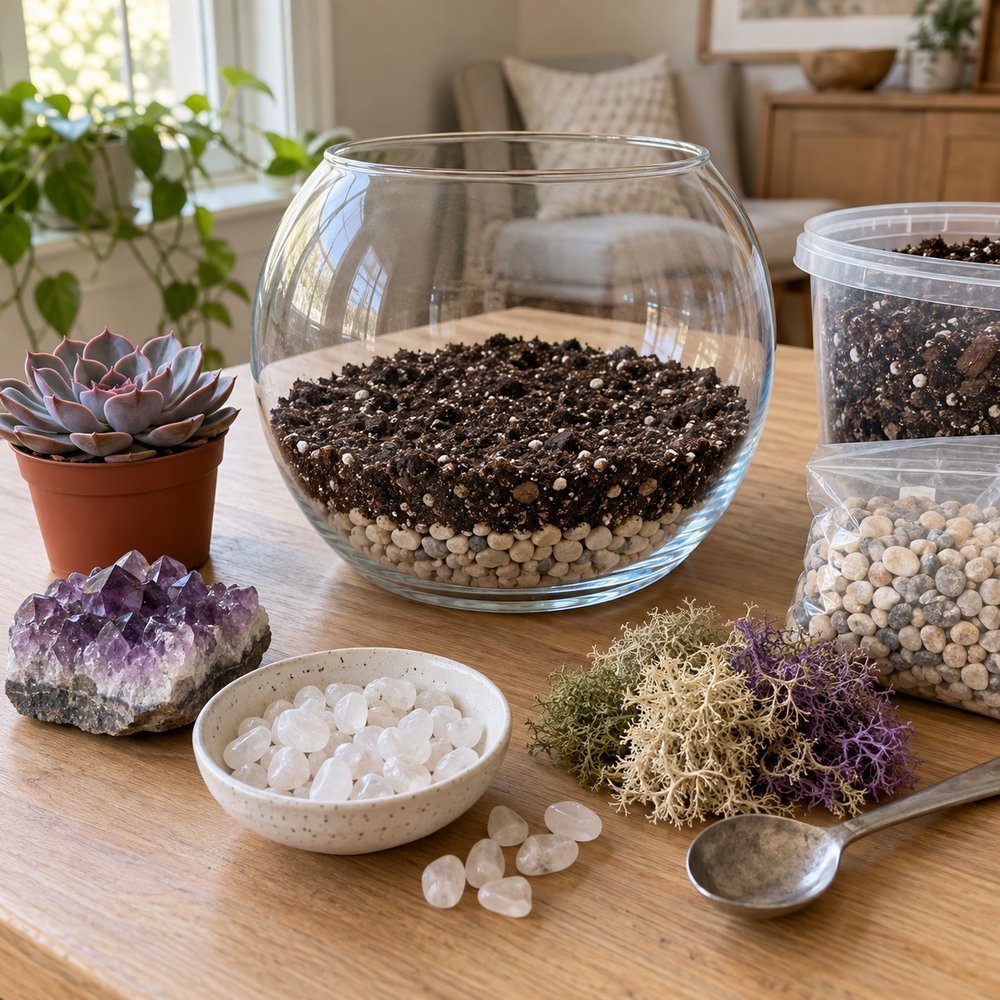
- Unpot the echeveria and gently loosen the surrounding nursery soil. Hold it by the root ball while deciding its position, keeping the leaf rosette above the planting surface.
- Make a planting hole, lower the roots into it and backfill gently. Leave the plant slightly off center, with a visible patch of soil beside it for the amethyst.
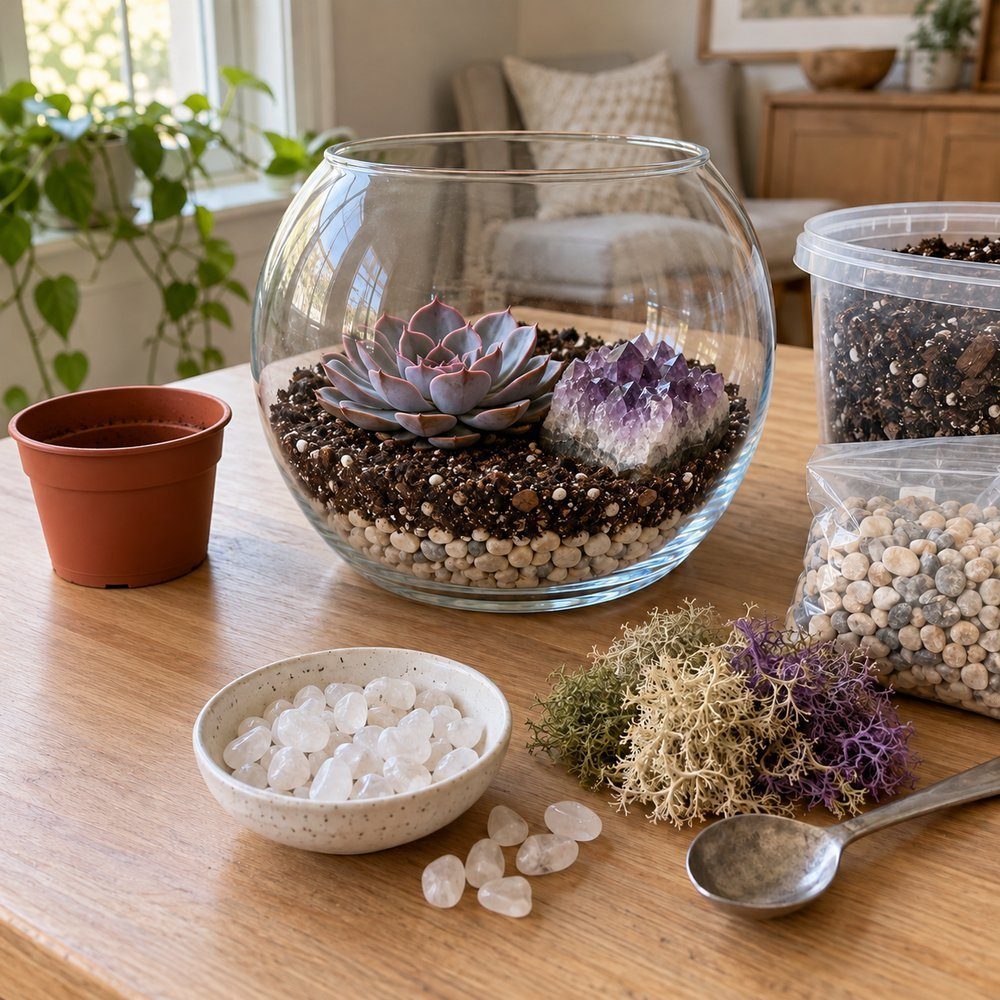
- Set the amethyst beside the rosette and tuck dried moss toward the back. Keep the crystal’s purple face visible from the front and leave the plant’s base accessible.
- Add a few quartz pebbles and the optional squirrel. Leave some soil showing so the finished surface reads as a planted miniature landscape with gaps between the stones.
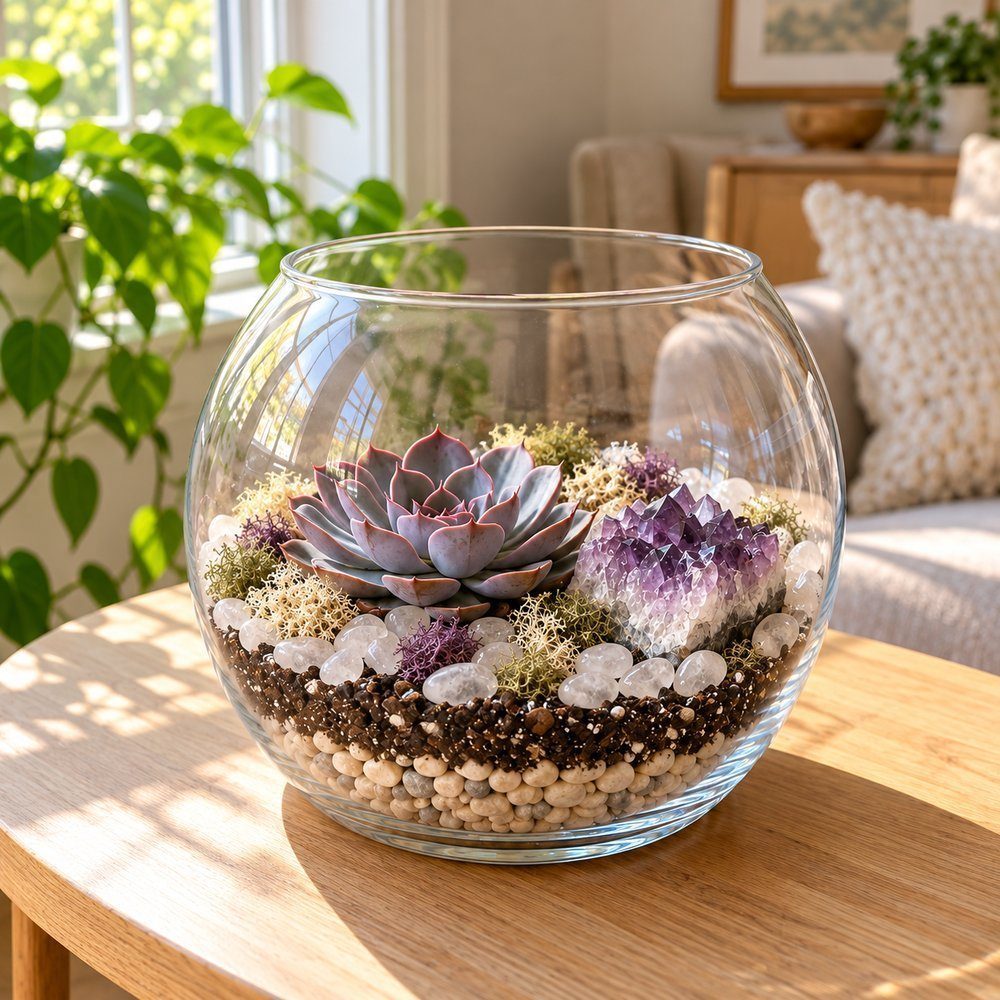
- Place the bowl where the succulent receives abundant light. For watering, follow Oregon State University Extension: let the soil dry completely, then water sparingly, often monthly or less. Direct water to the soil at the plant’s base.
For a moving demonstration, watch Daniela Kretchmer of AB Crafty build a succulent terrarium from a Creations by Nathalie kit. The video uses a different kit from the photographed bowl, so use it to follow the assembly process while keeping the open container and care guidance above.

Hanging succulent globe with gemstone terraces
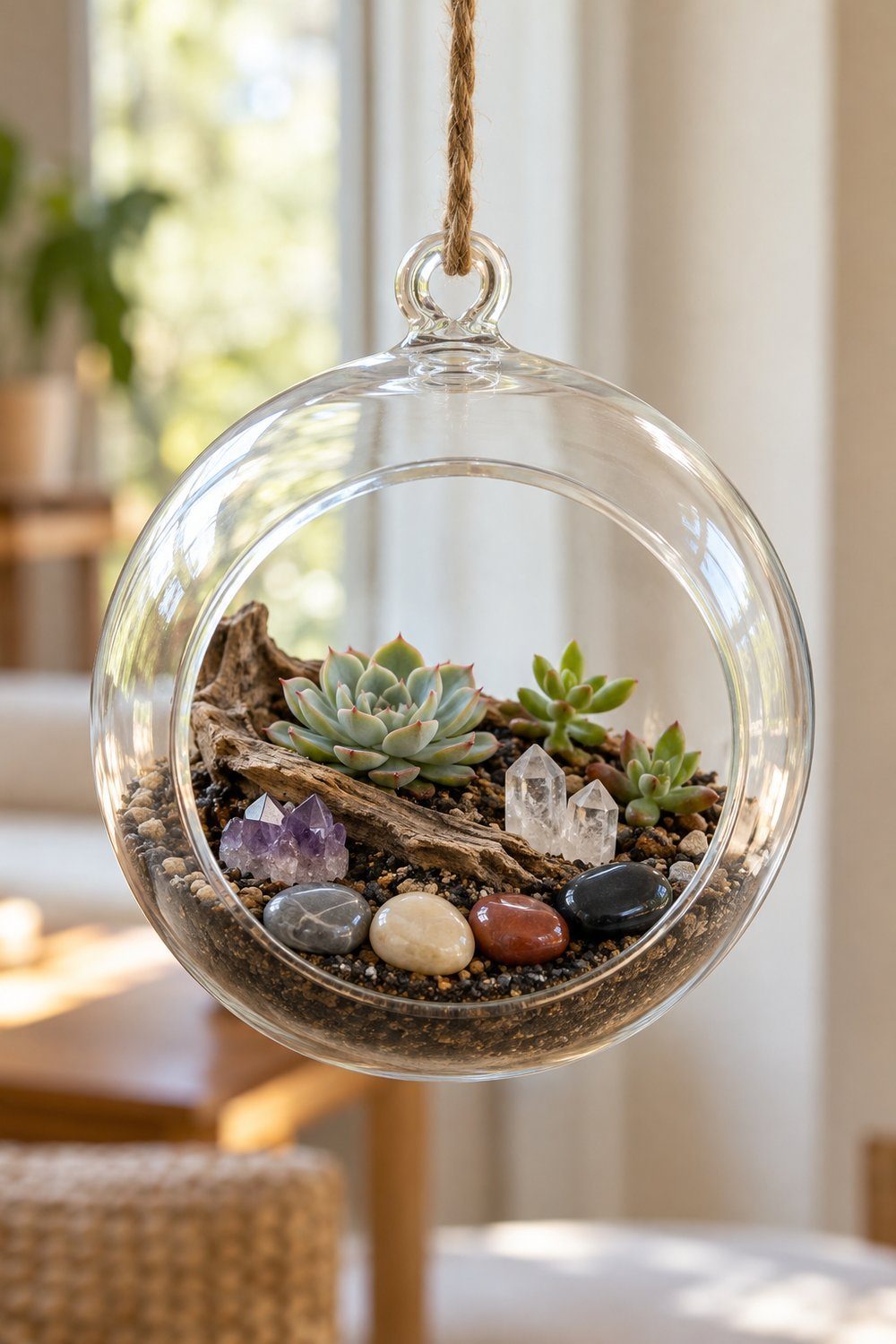
Dark sand and a little driftwood terrace give the hanging globe depth. Mix cactus potting medium into the planting area, fit the driftwood at an angle, and arrange the succulent cuttings with amethyst toward the front and quartz along the sides. The source crowds in several plants; here, use a sparse arrangement so each shape stays visible. Hang the globe where its side opening is reachable, or rest it in a supporting dish. Follow the dry-down guidance above; skip the tutorial’s daily spraying.
You'll need: the 4 in (10 cm) version of the hanging glass globe, cactus mix, dark sand, small succulent cuttings, driftwood, 3 gemstone pieces and 4 polished stones.
Tutorial by Florist in You, Florist in You
Open geode jar with succulents
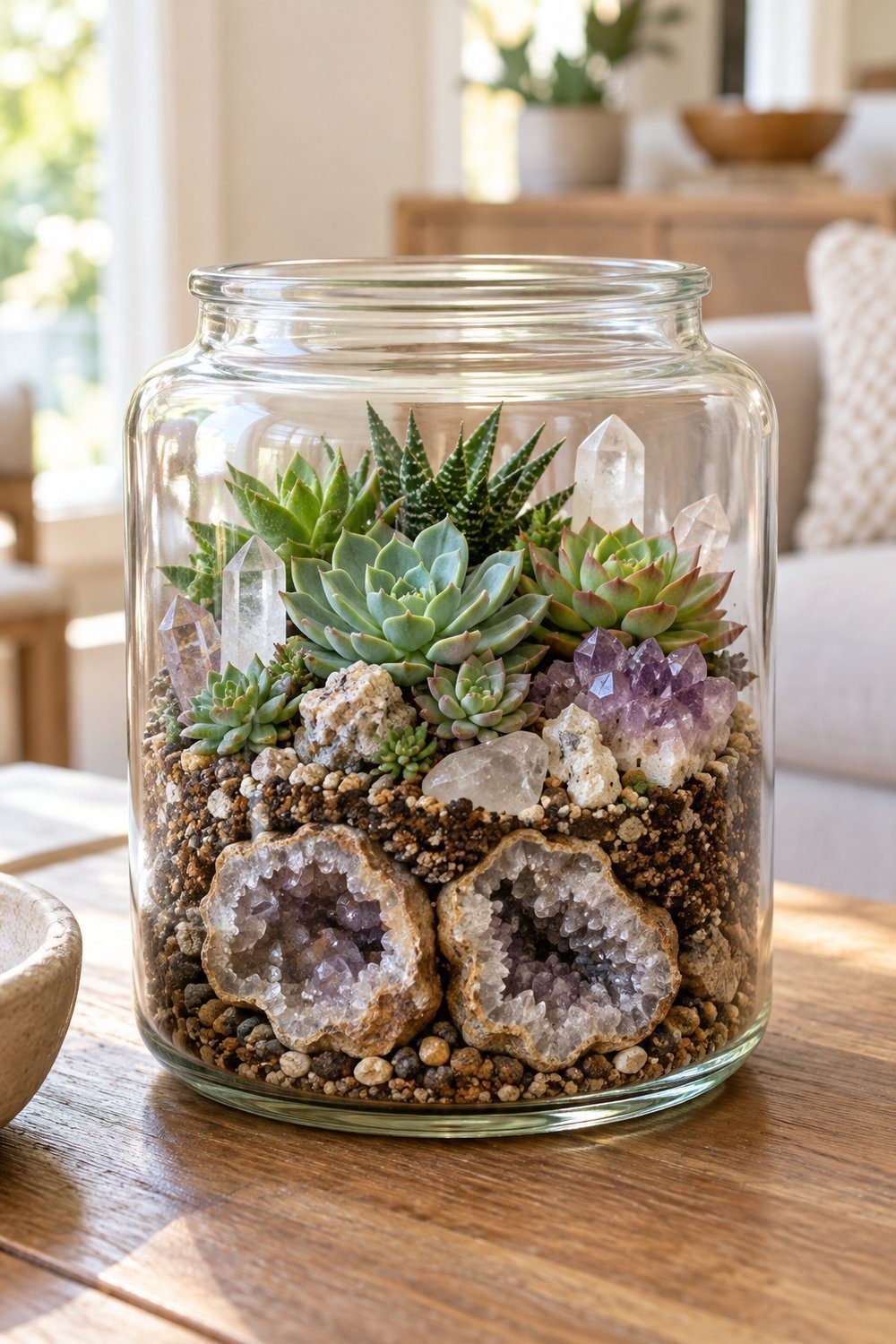
Outward-facing geode pieces give this jar its rocky foundation. The tutorial breaks a geode with a hammer; here, use already-open pieces, keeping the sparkling faces toward the glass. The tutorial uses soil; here, cactus mix. Plant the succulents and arrange quartz and amethyst around them. Use the geode as visual hardscape, with the soil managed as a container without drainage. Place this geode terrarium on a plant shelf where the lower crystal faces remain visible, clear of taller pots that could hide the jar’s most distinctive detail.
You'll need: 1 open glass jar, pre-opened geode pieces, amethyst, quartz, cactus mix and small succulents.
Tutorial by Lindsay Saito, credited repost, DIY Brico
Moss and ferns in a closed glass
Switch to living moss and humidity-loving foliage for these enclosed versions. Iowa State University Extension describes closed glass as a small water cycle and includes ferns among suitable plants. Keep the crystal visible at the front, with enough room to lift the lid and reach the planting.
Lidded fern garden with a crystal foreground
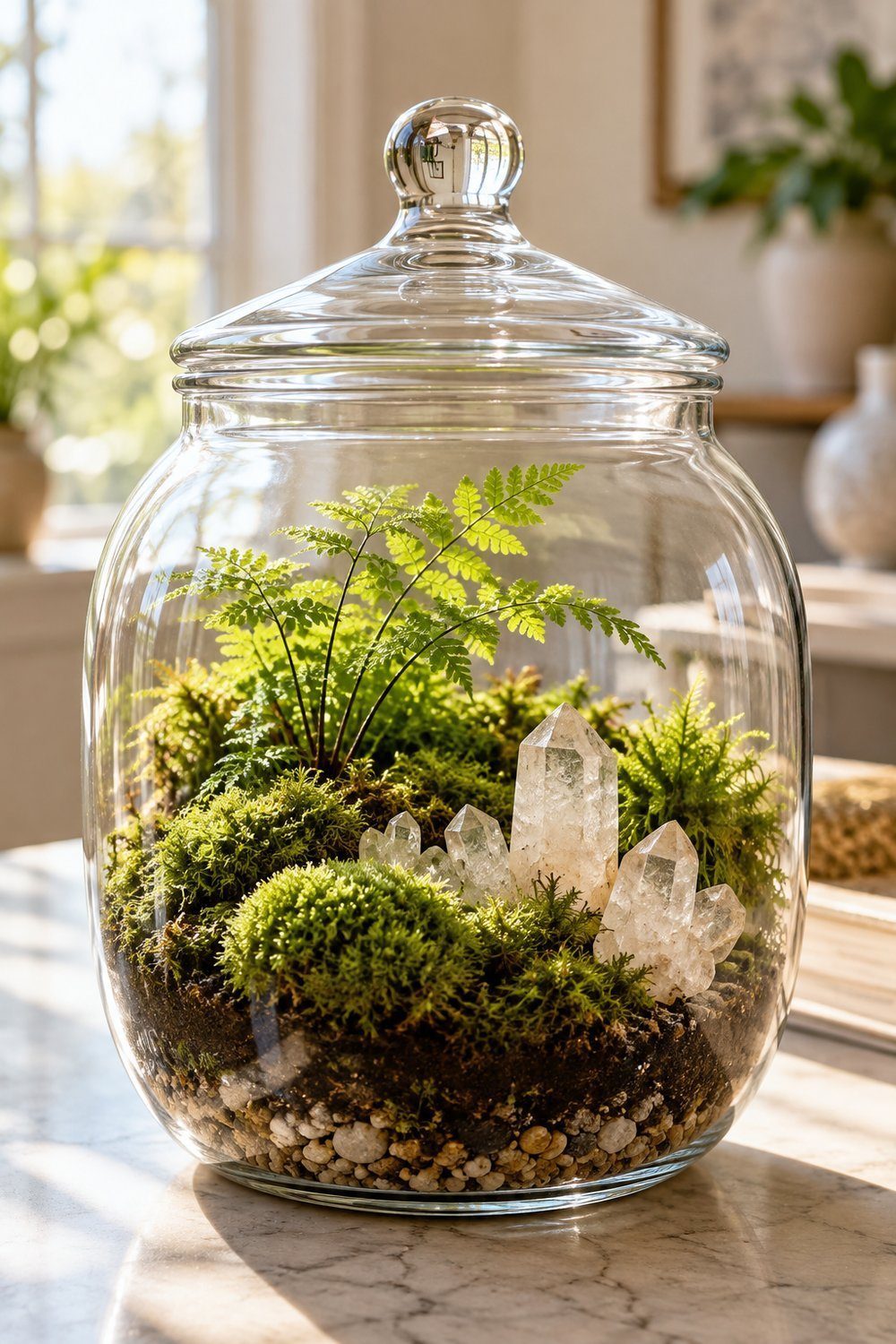
A fern gives a lidded garden height while living moss makes a green foreground. Add the substrate, plant the fern and moss, then set pale crystal points along the front before closing the vessel. The UC tutorial leaves its crystal mineral unidentified and adds isopods; here, choose quartz points and omit the animals and bark. This is the lushest terrarium with crystals in the group. Put it on a console in indirect light, with the front crystal band visible below the fern’s fronds.
You'll need: 1 small fern, living moss, a clear lidded vessel, terrarium substrate and pale crystal points.
Tutorial by Under the Solano Sun, UC Agriculture and Natural Resources
Repurposed lamp-shade cloche with a fern and geode
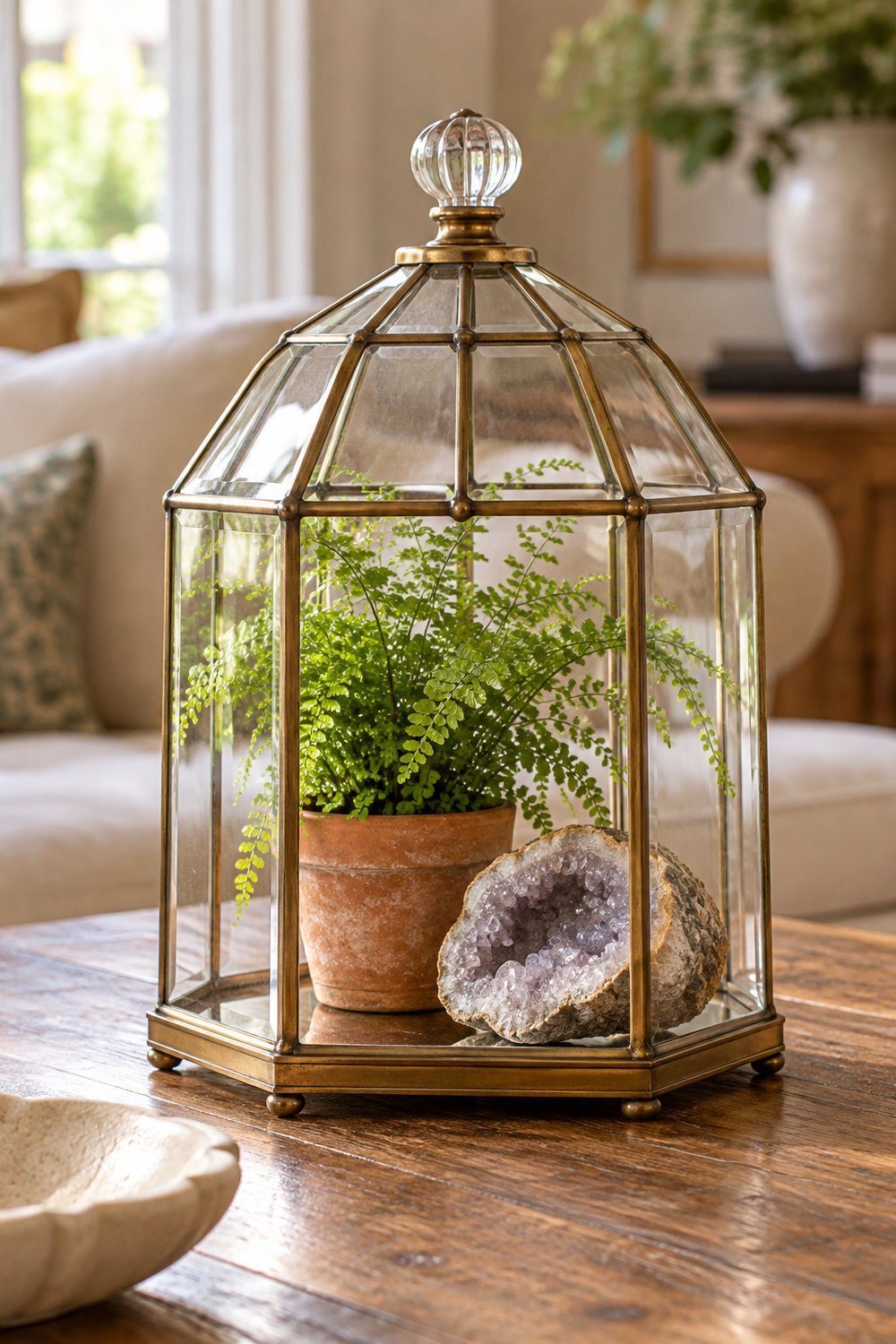
A vintage lamp shade becomes a geometric cloche around a potted fern and geode. Fit a glass knob into the shade’s existing top hole with nuts and washers, place the fern in its clay pot, and arrange the geode beside it before lowering the cover. The fern stays in its pot beneath the cloche. Set it on a stable sideboard base; the brass lines make a strong frame around the feathery foliage. Iowa State University Extension also supports keeping plants in their own pots beneath cloches.
You'll need: 1 repurposed glass pendant shade, a glass knob, nuts and washers, a potted fern and a geode.
Tutorial by Jennifer Rizzo, Jennifer Rizzo
Kids’ moss jar with a crystal accent
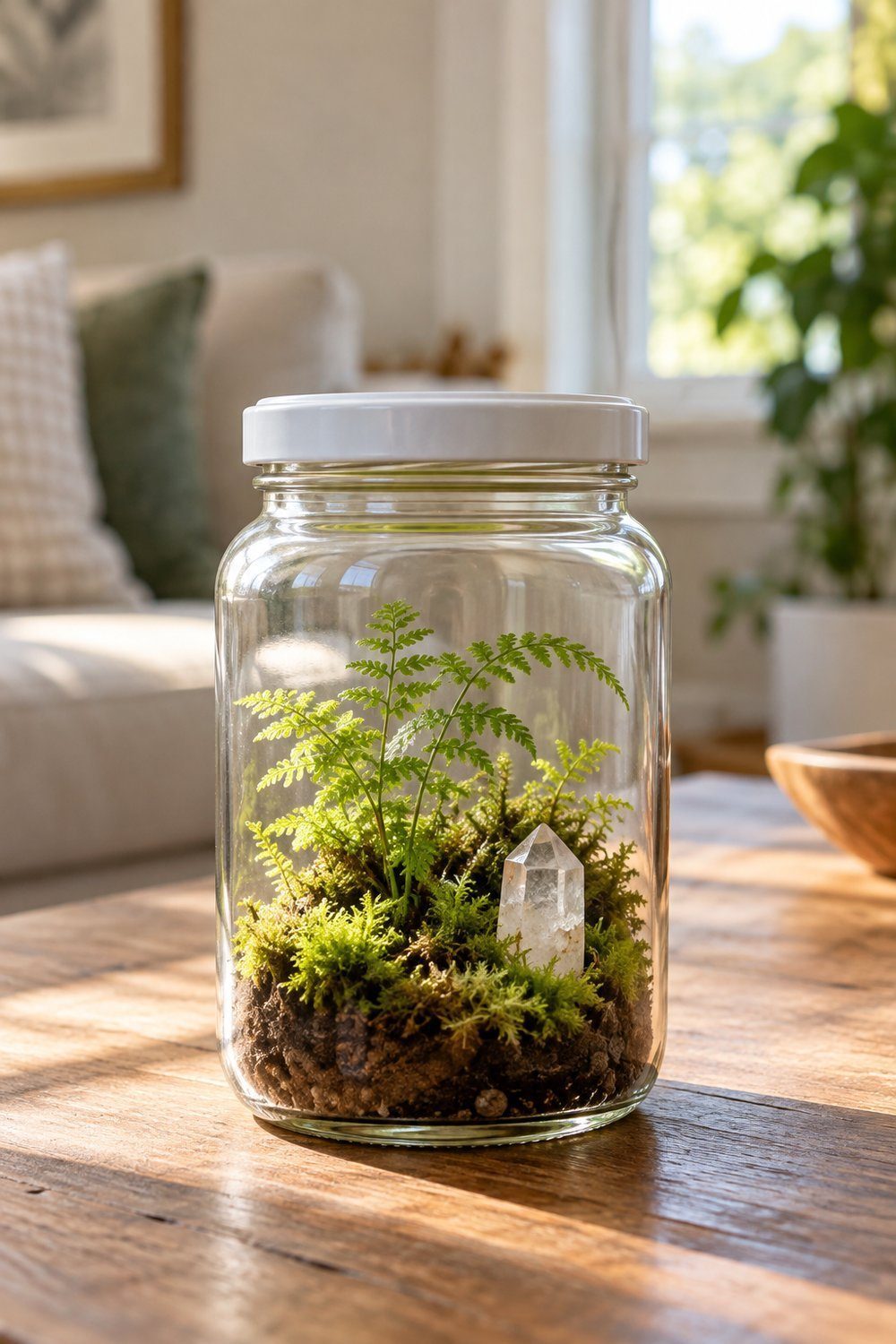
A sauce jar displays a children’s miniature garden on the kitchen table. The tutorial uses unspecified tiny plants; here, a small fern, as Iowa State lists ferns for closed terrariums. Build a shallow substrate layer, plant the fern, and tuck living moss around it with a chopstick. Finish with a crystal near the front. Valerie’s tutorial suggests glass gems or tumbled glass; here, replace them with quartz and add a lid for the humid planting. Let children position the moss and stone while an adult handles the glass. Leave the upper jar clear so the fern has a visible outline.
You'll need: 1 reused sauce jar with a lid, terrarium substrate, living moss, a small fern, a chopstick and a quartz accent.
Tutorial by Valerie E., Cut Out + Keep
Keeping a crystal terrarium looking good
Keep the care matched to the planting. According to Illinois Extension, air plants need indirect light and airflow; let them dry fully before returning them to glass. For succulents, use the complete soil dry-down described above. For closed fern gardens, Iowa State University Extension and Outreach recommends indirect light and temporarily uncovering the vessel when condensation becomes excessive.
Clean the glass while the opening is accessible. The UC tutorial wipes the inside after adding its soil layers; use that point in assembly to clear smears before placing crystals. Keep loose stones easy to lift out when you rearrange the scene. For the dry versions, preserve the contrast between the clear glass, soft dried materials and exposed mineral faces.
Next step: Explore a different glass treatment with Colored Sand Terrarium Layered in Clear Glass, practice a narrower planting format with Bottle Terrarium Planted Through a Narrow Neck, or plan the surrounding table arrangement with Centerpieces to Make at Home for Any Table.