Create a Rustic and Cozy Christmas Centerpiece


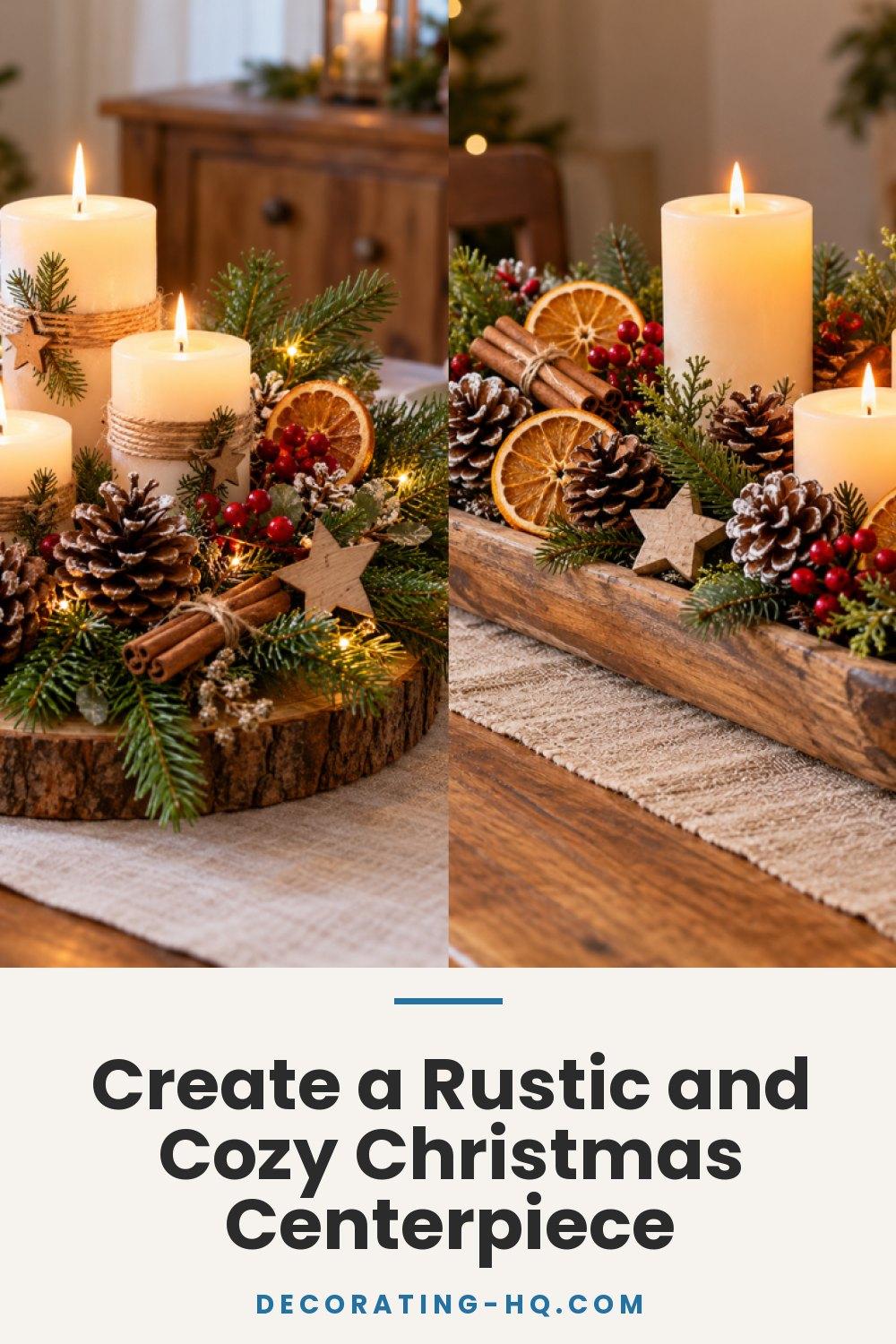
A rustic Christmas centerpiece does not need to be elaborate, expensive, or perfectly symmetrical. In fact, the most inviting arrangements often look as though they came together naturally: a few evergreen branches, pinecones collected outdoors, warm candlelight, a wooden tray, perhaps some dried oranges or berries, and enough empty space to let every detail breathe.
The rustic Christmas look is built around natural materials, warm textures, soft lighting, and restrained color. Pine, cedar, wood, stone, wool, berries, pinecones, and candlelight have all become prominent elements in cozy, woodland-inspired holiday decorating. Recent Christmas decorating trends have also leaned toward muted greens, chestnut browns, creams, nostalgic details, and softer illumination rather than overly bright or highly polished displays.
The result should feel less like a formal floral arrangement and more like a tiny winter landscape sitting in the middle of the table.
- Start with a Simple Rustic Base
- Build the Centerpiece with Evergreen Branches
- Add Pinecones for Natural Texture
- Introduce Warm Candlelight
- Add Dried Orange Slices
- Use Red Berries Sparingly
- Add a Few Wooden Details
- Create Height Without Blocking Conversation
- Choose a Rustic Christmas Color Palette
- A Simple Rustic Christmas Centerpiece Formula
- Conclusion
Start with a Simple Rustic Base
The easiest way to give a centerpiece structure is to begin with a base.
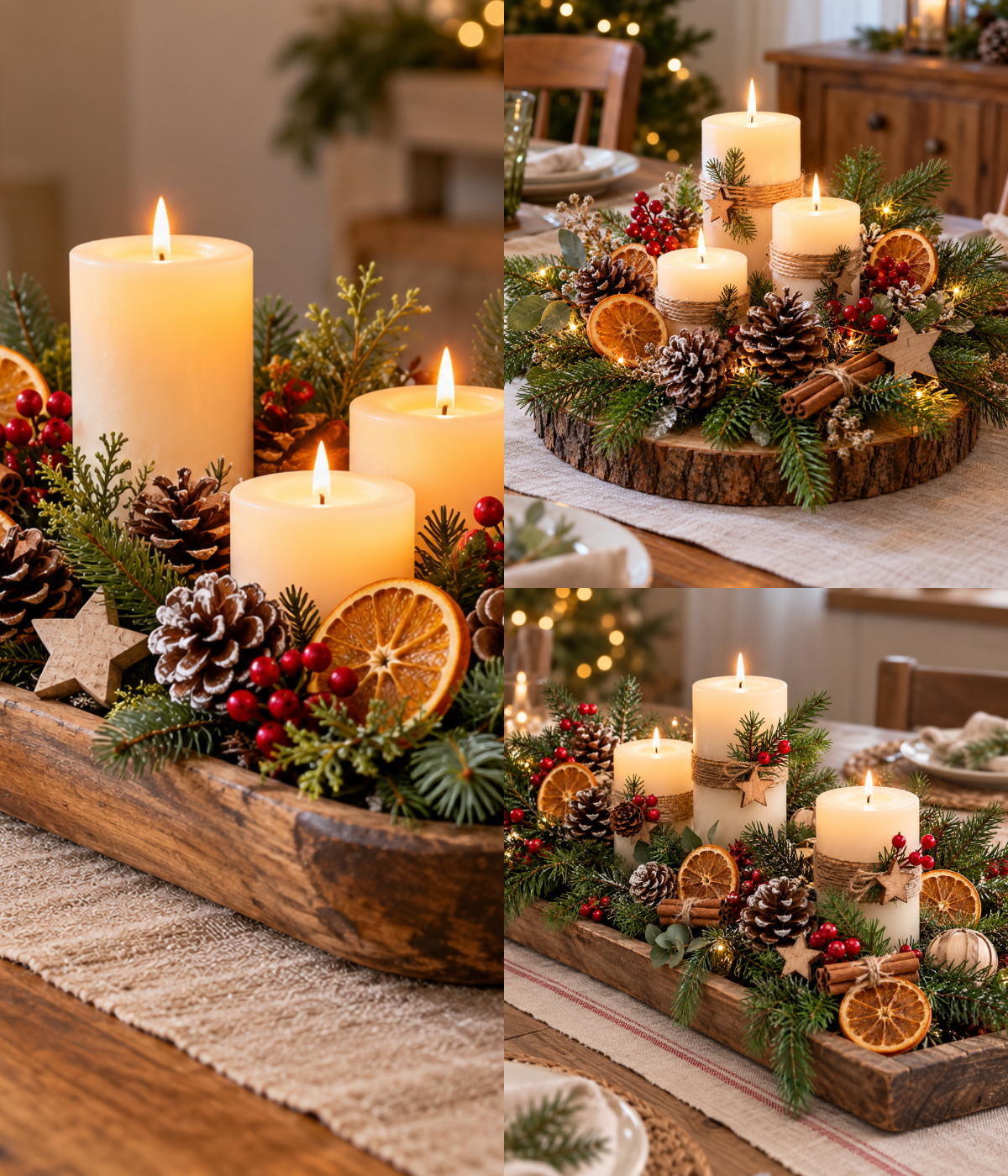
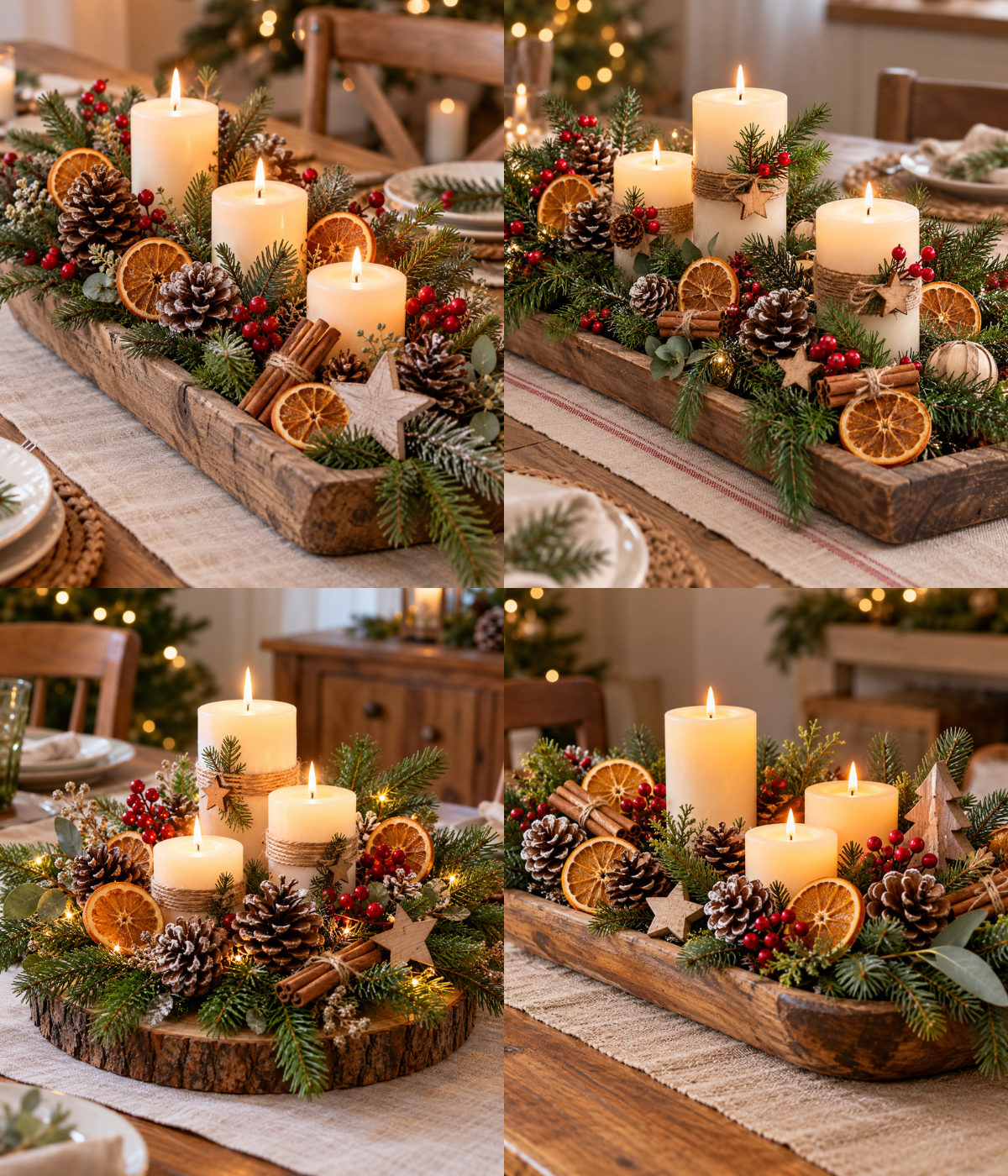
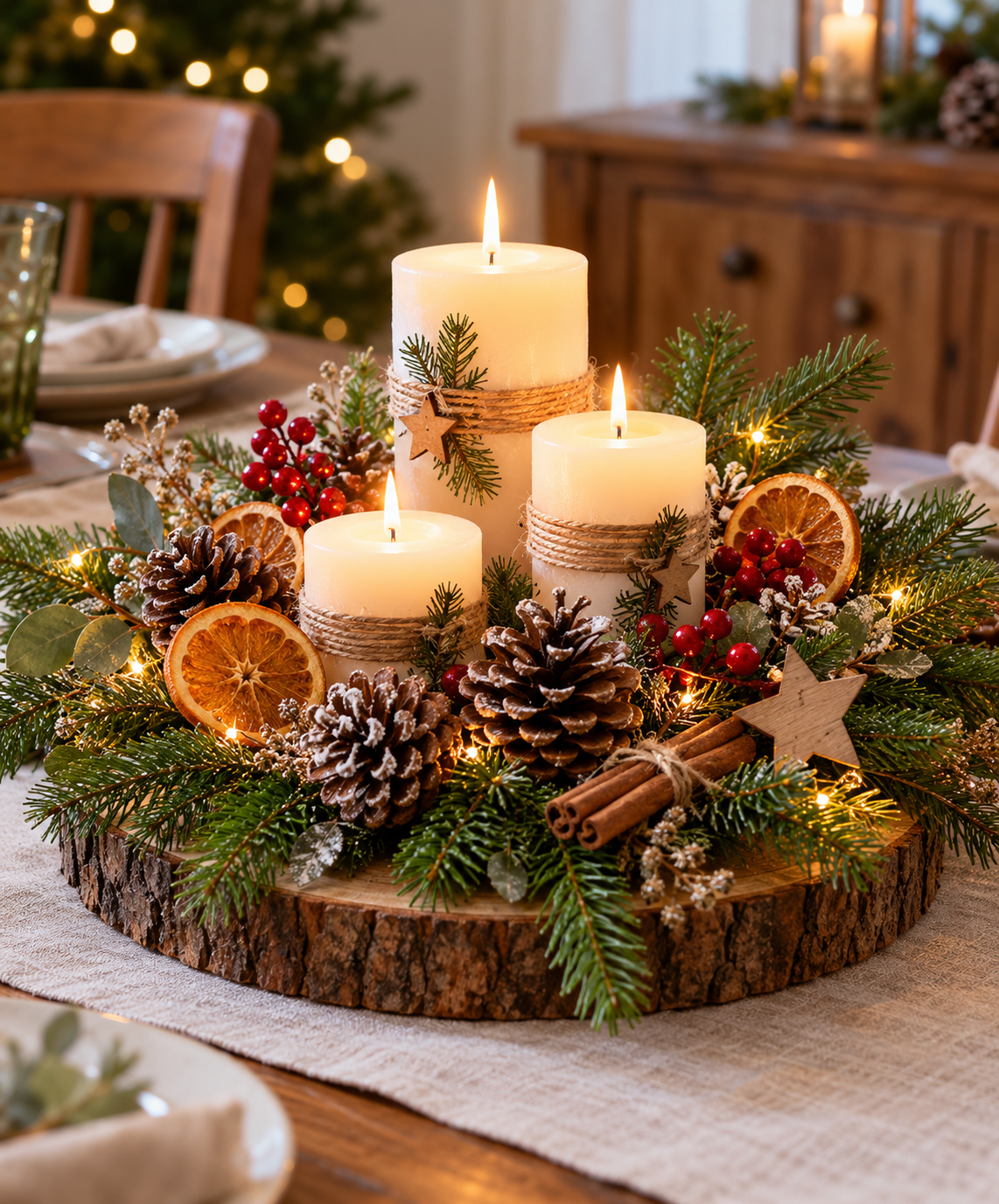
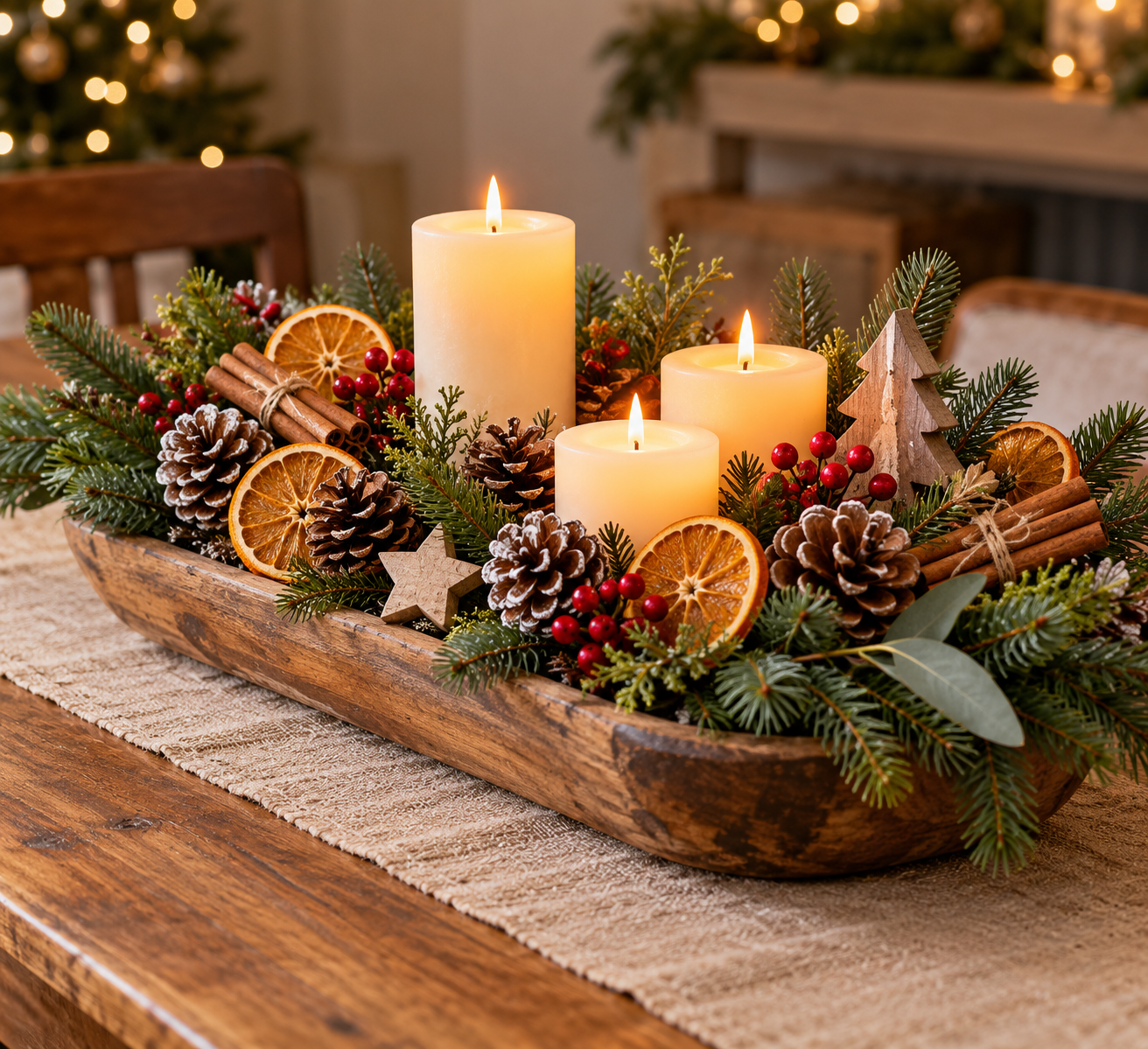
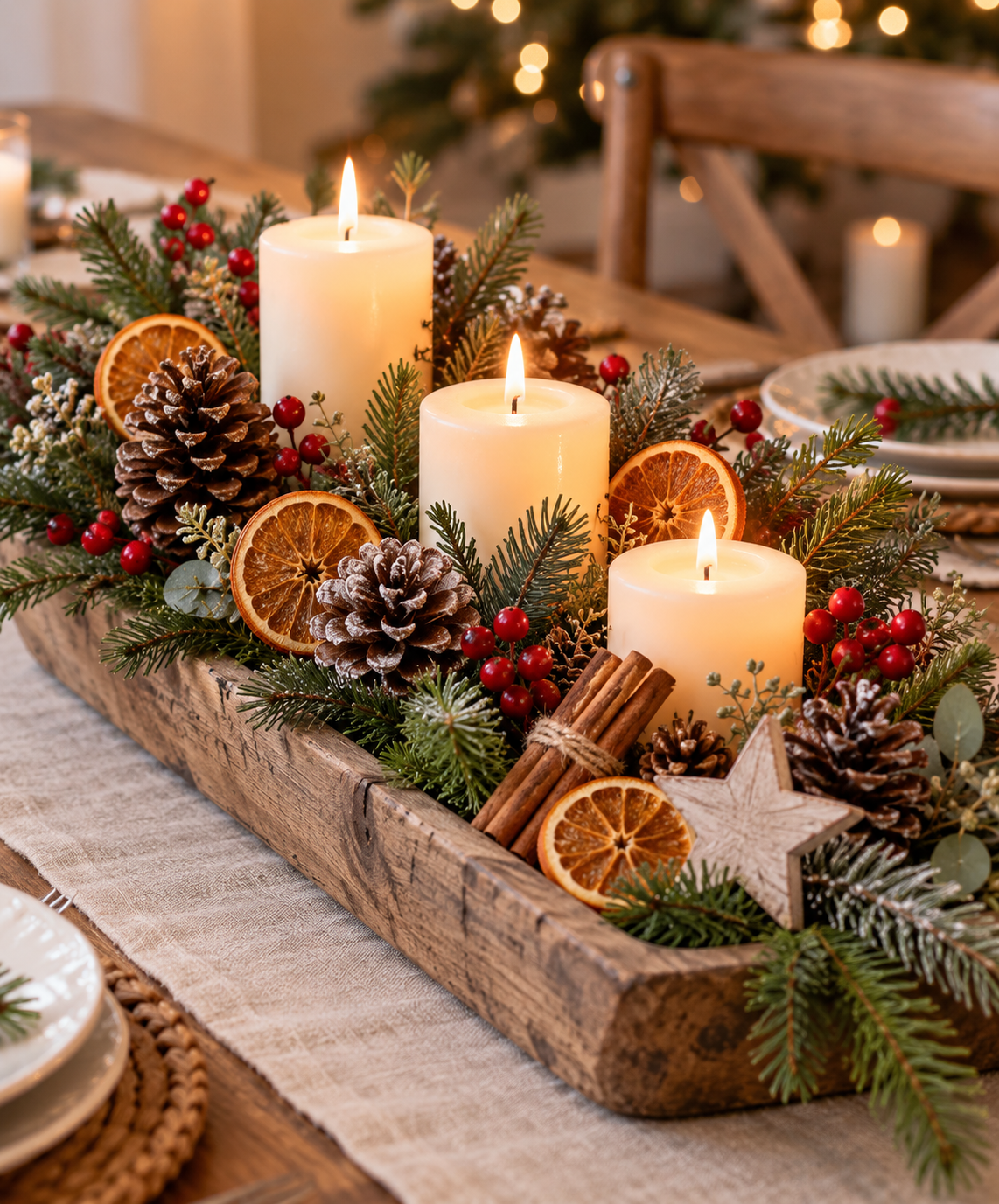
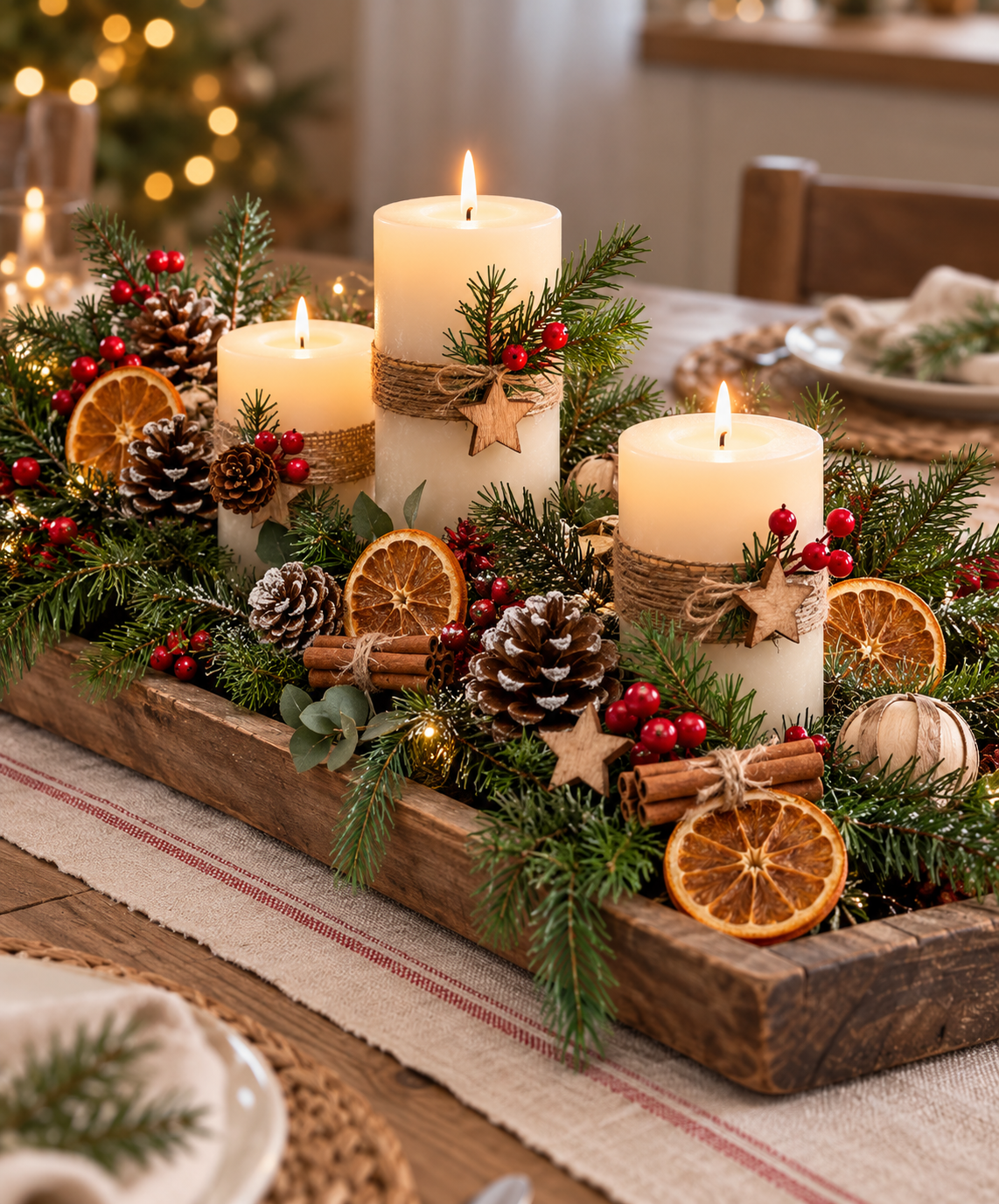
A wooden serving board, shallow basket, vintage tray, ceramic platter, or wood slice immediately establishes the rustic character of the arrangement. Natural wood works particularly well because its grain introduces texture before you have added a single decoration.
A long rectangular board suits a dining table, while a circular wood slice works beautifully on a smaller round table.
Avoid choosing a base that is too large. Your centerpiece should decorate the table rather than occupy it.
For a relaxed farmhouse style, you can even place the arrangement directly on a linen table runner.
Build the Centerpiece with Evergreen Branches
Greenery creates the foundation.
Fresh pine, cedar, fir, spruce, eucalyptus, or holly can all work, depending on what is available. Evergreen boughs and winter berries are traditional materials for tabletop holiday arrangements, while blue spruce and similar conifers provide especially attractive color and texture.
Cut branches into several different lengths rather than making everything identical.
Place the longest pieces first and allow some of them to extend beyond the edges of the tray. Add shorter branches over the top, rotating their direction slightly.
The arrangement should look layered rather than perfectly organized.
For an artificial centerpiece that can be reused every Christmas, mix several types of faux greenery instead of relying on one identical garland. Combining different needle shapes creates a much more convincing result.
Add Pinecones for Natural Texture
Few materials create a rustic Christmas atmosphere as easily as pinecones.
Use a mixture of large and small ones.
Leave some completely natural and lightly dust others with artificial snow or a small amount of white paint.
Pinecones work especially well when tucked between evergreen branches rather than simply placed on top.
Natural holiday decorating guides frequently combine pinecones with foliage, branches, wood, berries, and other materials gathered outdoors, precisely because these textures immediately create an earthy winter look.
You do not need many. Three to five pinecones are often enough for a medium centerpiece.
Introduce Warm Candlelight
Now add the element that changes everything: candles.
Use pillar candles of different heights for a relaxed composition. Cream, ivory, warm beige, burgundy, or deep green all complement rustic Christmas décor.
Avoid placing every candle in a straight line.
Instead, create small height differences.
For example:
- One tall ivory pillar candle
- One medium candle
- Two smaller votives
Candlelight is particularly effective with natural Christmas materials because it softens the greens and browns and creates the intimate glow associated with cozy holiday interiors. Current festive decorating advice frequently pairs candles or warm fairy lights with greenery and natural materials for exactly this reason.
If the centerpiece will remain on the table during dinner, battery-operated candles are a practical alternative.
They also allow greenery to sit closer to the light source without an open flame.
Add Dried Orange Slices
Dried citrus provides one of the prettiest color accents for a rustic centerpiece.
The translucent amber-orange color looks especially beautiful beside dark green foliage.
Arrange several dried orange slices between the branches, allowing some to remain partly hidden.
You can also stack two slices together and tie them with thin jute cord.
Dried citrus is frequently used alongside greenery and other natural Christmas materials because it contributes both color and an old-fashioned handcrafted quality. Better Homes & Gardens
For additional fragrance, combine dried orange with cinnamon sticks.
Tie two or three cinnamon sticks together using thin twine and place them casually near the candles.
Use Red Berries Sparingly
Red berries provide a classic Christmas contrast, but rustic decorating usually works better when red appears as an accent rather than dominating the entire composition.
Add small clusters of cranberries, faux winter berries, rose hips, or holly berries.
Place them in three or four areas around the centerpiece.
Repeated small touches create visual continuity without turning the arrangement into a bright red display.
If you prefer something more neutral, replace red berries with cream-colored berries, dried seed heads, or small white flowers.
Add a Few Wooden Details
Wooden stars, miniature houses, tiny trees, or simple handmade ornaments can add personality.
Choose unfinished or lightly stained wood rather than highly polished pieces.
A small wooden house hidden among the greenery can make the arrangement resemble a miniature winter village.
For something more understated, use just two carved wooden stars.
Rustic decorating becomes more convincing when the individual objects appear collected rather than purchased as one matching set.
Create Height Without Blocking Conversation
A beautiful Christmas centerpiece still needs to function on a dining table.
Keep the majority of the decoration fairly low.
If you want height, achieve it with narrow candles rather than bulky branches.
Guests sitting opposite one another should still be able to see and speak comfortably.
A useful approach is to concentrate taller elements near the middle and gradually lower the arrangement toward the ends.
This also gives the centerpiece a natural visual rhythm.
Choose a Rustic Christmas Color Palette
You do not need the traditional bright red-and-green combination.
For a more sophisticated cozy Christmas centerpiece, try one of these palettes:
- Forest green, cream and natural wood
- Moss green, burgundy and brown
- White, eucalyptus green and antique gold
- Deep green, rust orange and beige
- Pine green, cranberry red and warm brass
The more restrained the palette, the easier it becomes to combine different textures.
A Simple Rustic Christmas Centerpiece Formula
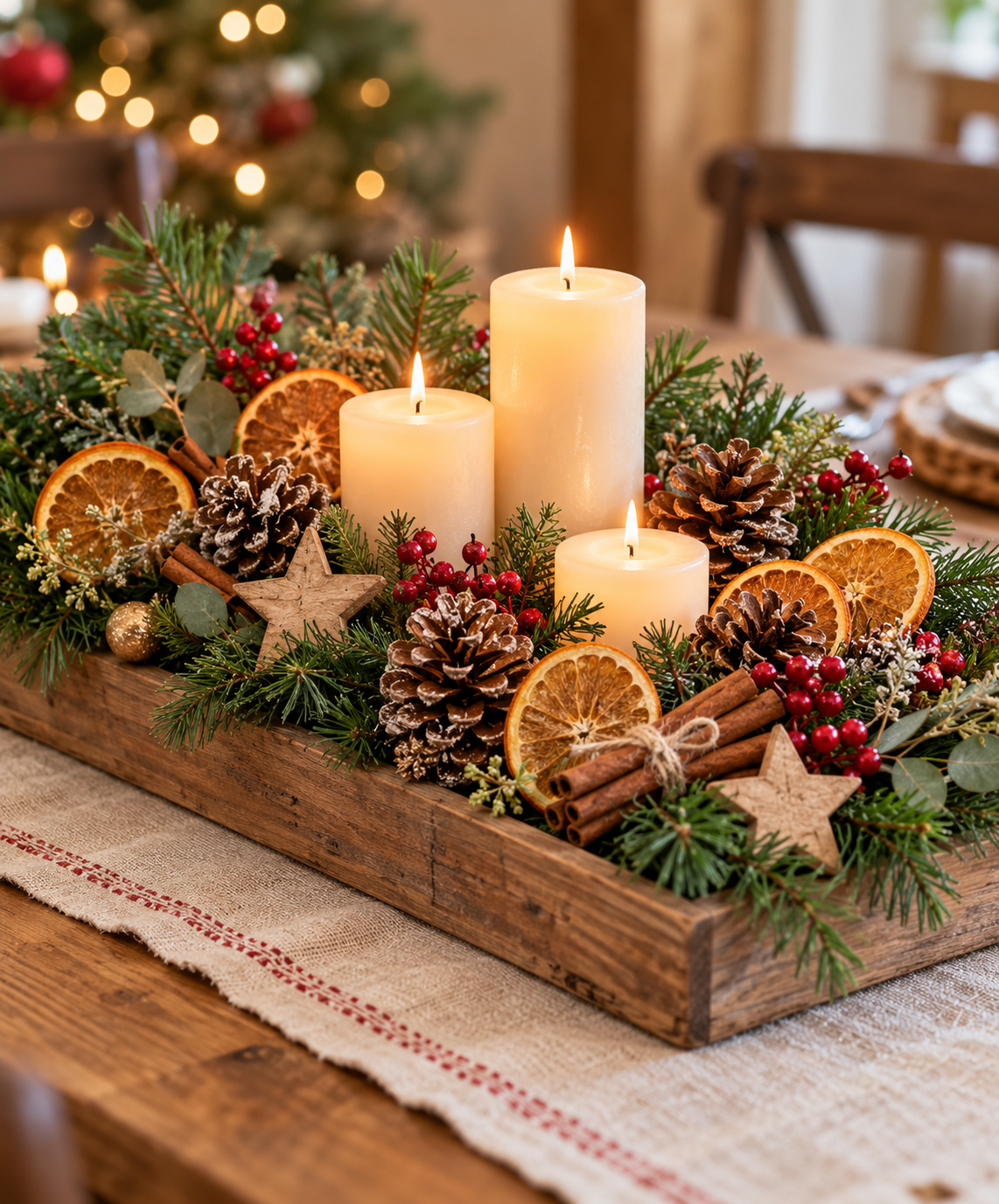
If you want a straightforward arrangement that is difficult to get wrong, use this combination:
- Place a wooden tray in the center of the table.
- Arrange evergreen branches loosely along its length.
- Add three ivory pillar candles at different heights.
- Tuck five pinecones between the greenery.
- Add four or five dried orange slices.
- Introduce several small groups of red berries.
- Place two bundles of cinnamon sticks near the candles.
- Finish with one or two wooden stars.
Then stop.
The temptation to keep adding things is usually stronger than the need to add them.
A rustic centerpiece should feel generous but never crowded. Let natural materials provide the decoration.
Conclusion
Creating a rustic and cozy Christmas centerpiece is less about following a precise formula and more about combining materials that naturally belong together.
Evergreen branches provide structure. Pinecones add texture. Candles introduce warmth. Dried oranges and berries bring restrained color. Wood prevents the arrangement from feeling overly polished.
Most importantly, resist perfection.
Let branches fall slightly differently on each side. Mix pinecones of different sizes. Use candles that are not exactly the same height.
Those small irregularities are what give a rustic centerpiece its character.
The finished table should feel warm, inviting and quietly festive — as though a little piece of the winter landscape has been brought indoors for Christmas dinner.